
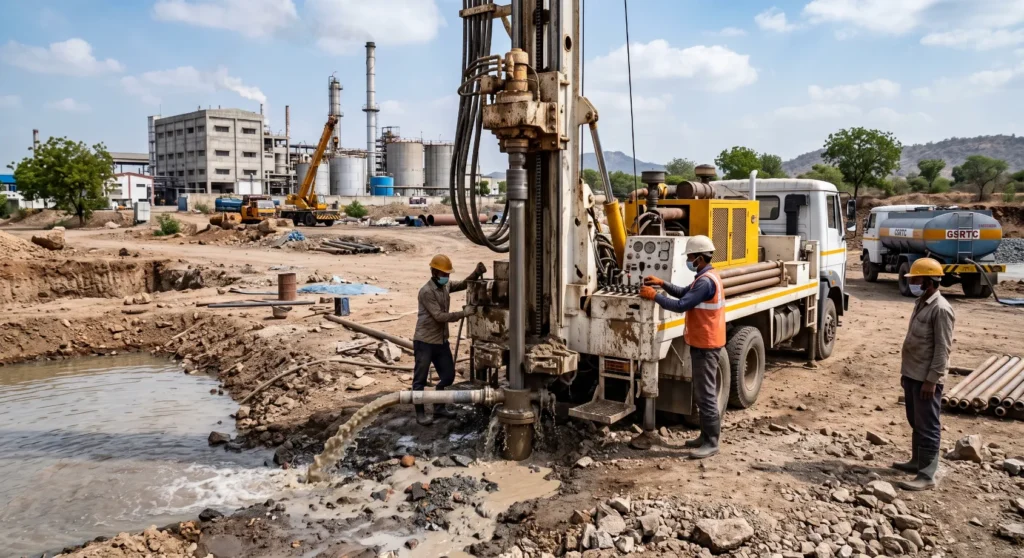
Industrial Borewell Requirements and CGWA NOC Process in India: A Complete Guide
Introduction
Groundwater is an essential resource for many industries in India. Manufacturing plants, chemical industries, pharmaceutical units, food-processing facilities, infrastructure projects and other commercial establishments often depend on borewells to meet their operational water requirements.
However, installing and operating an industrial borewell involves more than simply drilling a borewell. Depending on the location, purpose and volume of groundwater extraction, industries may be required to obtain a No Objection Certificate (NOC) from the appropriate groundwater authority and comply with various monitoring, recharge, conservation and reporting requirements.
This guide explains the key requirements for industrial borewells and provides an overview of the CGWA NOC process in India.
Important: Groundwater regulations and conditions may vary depending on the location and applicable State/UT regulations. Industries should always verify the latest requirements with the competent authority before starting groundwater extraction. CGWA guidelines also establish a framework for regulating and controlling groundwater extraction across India.
What Is CGWA?
CGWA stands for the Central Ground Water Authority. It is responsible for regulating and controlling groundwater extraction under the applicable legal and regulatory framework.
The authority issues No Objection Certificates for eligible categories of projects and establishes conditions for sustainable groundwater extraction. Depending on the State or Union Territory and local regulatory framework, groundwater extraction may also be regulated by the relevant State or UT authority.
Therefore, the first step for any industrial project is determining which authority has jurisdiction over the proposed borewell location.
Why Is a CGWA NOC Important for Industries?
Groundwater is a limited natural resource. Uncontrolled extraction can result in:
Falling groundwater levels
Reduced water availability
Higher pumping costs
Environmental impacts
Conflicts between industrial and community water requirements
A groundwater NOC helps authorities assess whether groundwater extraction is appropriate for the proposed project and whether adequate conservation and monitoring measures are in place.
Industries may also be required to follow conditions related to:
Groundwater quantity
Water conservation
Groundwater recharge
Flow measurement
Groundwater level monitoring
Water quality monitoring
Periodic reporting
Water audits
Does Every Industrial Borewell Require a CGWA NOC?
Not every project follows exactly the same approval process. Requirements depend on several factors, including:
Project location
Type of industry
Quantity of groundwater required
Purpose of groundwater extraction
Whether the project is new or existing
Whether the industry is expanding
Applicable State or UT regulations
Local groundwater conditions
CGWA guidelines broadly cover industries, infrastructure projects and mining projects extracting groundwater, subject to applicable exemptions and conditions.
Before drilling a borewell, it is advisable to determine:
Which authority regulates groundwater extraction in your project area.
Whether a prior NOC is required.
Whether the proposed project qualifies for any exemption.
What technical documents are required for the application.
What monitoring and compliance conditions will apply after approval.
Key Requirements for an Industrial Borewell
1. Proper Borewell Location Selection
Selecting the correct location is one of the most important stages of an industrial borewell project.
The borewell location should be evaluated based on:
Geological conditions
Hydrogeological conditions
Aquifer characteristics
Existing groundwater levels
Nearby borewells
Water demand
Pollution risks
Site layout
Long-term sustainability
Random borewell drilling may result in poor water yield, excessive drilling depth or water quality problems.
A professional hydrogeological survey can help identify suitable locations and assess the groundwater potential of the project site.
2. Hydrogeological Investigation
For industrial groundwater applications, a hydrogeological assessment may be required depending on the project and applicable authority requirements.
A hydrogeological study may include:
Geological details of the site
Groundwater conditions
Existing groundwater structures
Water level information
Aquifer details
Proposed groundwater extraction
Groundwater recharge potential
Water balance assessment
Impact of proposed extraction
CGWA guidelines include an outline for hydrogeological reports for industries seeking groundwater NOCs.
3. Accurate Assessment of Water Requirement
Industries should calculate their actual water requirement before applying for an NOC.
The assessment should consider:
Process water requirement
Cooling water
Boiler requirements
Domestic water use
Gardening and greenbelt requirements
Water losses
Future expansion requirements
Reuse and recycling potential
The application should be based on realistic and technically supported water demand.
Overestimating or underestimating water requirements can create difficulties during regulatory approval and future compliance.
4. Borewell Drilling Design
Industrial borewell construction should be designed according to the geological and hydrogeological conditions of the site.
The design may involve:
Suitable drilling method
Appropriate bore diameter
Proper casing pipe
Strainer or screen installation where required
Gravel packing where required
Borewell development
Yield testing
Pump testing
Common drilling methods include:
Direct Rotary Drilling
Direct Rotary drilling is commonly suitable for soft and unconsolidated formations.
DTH Drilling
Down-the-Hole (DTH) drilling is commonly used for hard rock formations.
The correct drilling method should be selected according to the actual ground conditions at the site.
5. Installation of a Water Flow Meter
Accurate measurement of groundwater extraction is essential for industrial groundwater management.
Depending on the applicable NOC conditions, industries may be required to install suitable water flow measurement systems.
For industrial applications, electromagnetic water flow meters can provide reliable measurement of groundwater extraction.
Advanced systems may also provide:
Digital water consumption records
Remote monitoring
IoT connectivity
Automated data logging
Real-time water-use information
Proper monitoring helps industries maintain compliance and improve water efficiency.
6. Piezometer and Groundwater Monitoring
A piezometer is used to monitor groundwater levels and, in certain applications, groundwater quality.
Monitoring systems may include:
Manual water level measurement
Digital water level recorder
Telemetry-based monitoring
Periodic water quality testing
Groundwater monitoring helps track changes in the aquifer and supports sustainable extraction practices. CGWA guidelines include requirements and technical guidance related to piezometer construction and groundwater monitoring.
7. Rainwater Harvesting and Groundwater Recharge
Rainwater harvesting is an important component of sustainable industrial water management.
Industries can capture rainwater from:
Rooftops
Open areas
Industrial premises
Stormwater drainage systems
Depending on local conditions, collected rainwater may be used for:
Direct storage
Groundwater recharge
Process water after suitable treatment
Landscaping requirements
A properly designed recharge system can support groundwater conservation and reduce dependence on external water sources.
8. Water Conservation and Recycling
Before depending heavily on groundwater, industries should explore water-saving measures.
These may include:
Water-efficient equipment
Recycling of treated wastewater
Reuse of process water
Leak detection
Zero or low discharge practices where applicable
Water audits
Real-time water monitoring
Reducing groundwater demand can improve both regulatory compliance and operational efficiency.
CGWA NOC Application Process: Step-by-Step
Step 1: Check Groundwater Regulatory Authority
First, identify the authority responsible for groundwater regulation in the project location.
Depending on the State or UT, the application may fall under:
Central Ground Water Authority (CGWA)
State Groundwater Authority
Other competent groundwater regulatory authority
This is a critical first step because the applicable authority and process may vary by location.
Step 2: Prepare Technical and Legal Documents
The exact document list may vary, but an industrial application may require information and documents such as:
Company details
Project location details
Land ownership or site documents
Industrial approvals
Water requirement details
Existing water sources
Proposed groundwater extraction
Borewell details
Hydrogeological report, where applicable
Water balance information
Rainwater harvesting or recharge plan
Piezometer and monitoring plan
Pollution-control-related documents, where applicable
Supporting statutory approvals
Applicants should ensure that all documents are accurate and consistent.
Step 3: Conduct Hydrogeological Assessment
Where required, the applicant should prepare a technical hydrogeological report.
The report may include:
Site geology
Groundwater conditions
Aquifer characteristics
Existing wells
Groundwater level data
Proposed groundwater extraction
Recharge potential
Sustainability assessment
A well-prepared report can help demonstrate that the proposed groundwater extraction has been properly evaluated.
Step 4: Prepare a Water Management Plan
The water management plan should explain:
Total water requirement
Groundwater requirement
Alternative water sources
Water recycling
Wastewater treatment
Rainwater harvesting
Groundwater recharge
Water conservation measures
Authorities generally expect industries to use groundwater responsibly and reduce unnecessary extraction.
Step 5: Submit the Application Through the Applicable Portal
The NOC application is submitted through the applicable regulatory process and online system.
The applicant should:
Create the required registration or account.
Enter project information.
Provide water requirement details.
Upload supporting documents.
Submit the required declarations.
Pay applicable fees, where required.
Respond to any observations or additional information requests.
It is important to ensure that the information provided in the application matches the actual project conditions.
Step 6: Technical Scrutiny and Review
After submission, the competent authority may review:
Project location
Groundwater conditions
Proposed extraction quantity
Industry category
Hydrogeological information
Water conservation measures
Recharge plans
Monitoring arrangements
Additional documents or clarifications may be requested during the review process.
Step 7: NOC Approval and Compliance Conditions
If approved, the NOC may contain specific conditions that the industry must follow.
Conditions may relate to:
Permitted groundwater extraction
Installation of flow meters
Groundwater monitoring
Piezometer installation
Rainwater harvesting
Artificial recharge
Periodic water-level monitoring
Water quality monitoring
Online monitoring or telemetry
Water audits
Reporting requirements
The industry must carefully read and comply with every condition mentioned in the approval.
Common Documents Required for an Industrial Groundwater NOC
Although requirements may vary, industries should generally be prepared with:
Company registration documents
PAN and GST details
Site address and location information
Land ownership documents
Industry approval documents
Water requirement calculation
Existing water source details
Proposed borewell details
Hydrogeological report, where applicable
Water balance
Rainwater harvesting plan
Groundwater recharge proposal
Piezometer monitoring plan
Flow meter proposal
Water conservation plan
Other documents requested by the competent authority
Common Mistakes Industries Should Avoid
Drilling Before Checking NOC Requirements
Starting borewell drilling without verifying regulatory requirements can create compliance problems.
Always check the applicable authority and approval process before proceeding.
Incorrect Water Requirement Calculation
Water requirements should be based on actual operational demand and supported by calculations.
Poor Documentation
Incomplete or inconsistent documentation can delay the application.
Ignoring Groundwater Monitoring
Monitoring is not only a regulatory requirement in applicable cases; it is also essential for long-term water management.
Not Installing Proper Flow Measurement Systems
Industries should use reliable water measurement systems appropriate for their groundwater extraction requirements.
Ignoring Rainwater Harvesting
Rainwater harvesting and recharge can reduce pressure on groundwater resources and improve the overall sustainability of the project.
How Vishal Borewell Drilling Service Can Help
Vishal Borewell Drilling Service, Vadodara, Gujarat, provides technical support for industrial and groundwater-related projects.
Our services include:
Industrial borewell drilling
Hydrogeological survey support
Borewell location guidance
DTH drilling
Direct Rotary drilling
Borewell development
Electromagnetic digital water flow meters
IoT-based water monitoring
Piezometer installation
Digital Water Level Recorder (DWLR) telemetry solutions
Rainwater harvesting consultancy
Groundwater recharge solutions
Support for groundwater and CGWA-related project requirements
With 40+ years of experience and 8,000+ successful borewell projects, we help industries develop reliable and sustainable groundwater solutions.
Frequently Asked Questions
Is a CGWA NOC mandatory for an industrial borewell?
The requirement depends on the project location, groundwater extraction purpose, industry category and the applicable regulatory authority. Industries should verify the latest requirements before drilling or extracting groundwater.
Can an industry drill a borewell before obtaining the required NOC?
Industries should first verify the applicable approval requirements. Starting groundwater extraction without required permissions may result in regulatory or compliance issues.
What is NOCAP?
NOCAP is associated with the online process used for groundwater NOC applications and management under the applicable groundwater regulatory framework.
What is a piezometer?
A piezometer is a monitoring structure used to measure groundwater levels and support groundwater monitoring.
Why is a flow meter required for industrial borewells?
A flow meter helps accurately measure the quantity of groundwater being extracted and supports water management and compliance monitoring.
What is the difference between a hydrogeological survey and borewell drilling?
A hydrogeological survey evaluates groundwater conditions and the suitability of a site. Borewell drilling is the physical construction of the groundwater extraction structure.
Can rainwater harvesting help industrial groundwater management?
Yes. A properly designed rainwater harvesting and recharge system can help conserve water, reduce dependence on groundwater and support sustainable water management.
Conclusion
An industrial borewell should be planned as a complete groundwater management project—not simply as a drilling activity.
Before starting the project, industries should:
Check applicable NOC requirements
Identify the competent groundwater authority
Assess water requirements accurately
Conduct hydrogeological investigations where required
Design the borewell correctly
Install reliable flow monitoring systems
Implement groundwater monitoring
Develop rainwater harvesting and recharge systems
Follow all applicable NOC conditions
With proper planning, technical expertise and regulatory compliance, industries can develop more reliable and sustainable groundwater systems.
Need Help with Industrial Borewell or Groundwater Compliance?
Vishal Borewell Drilling Service provides industrial borewell drilling, groundwater monitoring, flow meter, piezometer, telemetry and rainwater harvesting solutions.
📞 Call: +91 84698 77021
🌐 Website: vishalborewell.com
📍 Vadodara, Gujarat, India
Regulatory requirements can change. Always verify the latest rules, authority requirements and NOC conditions before starting any industrial groundwater extraction project.