
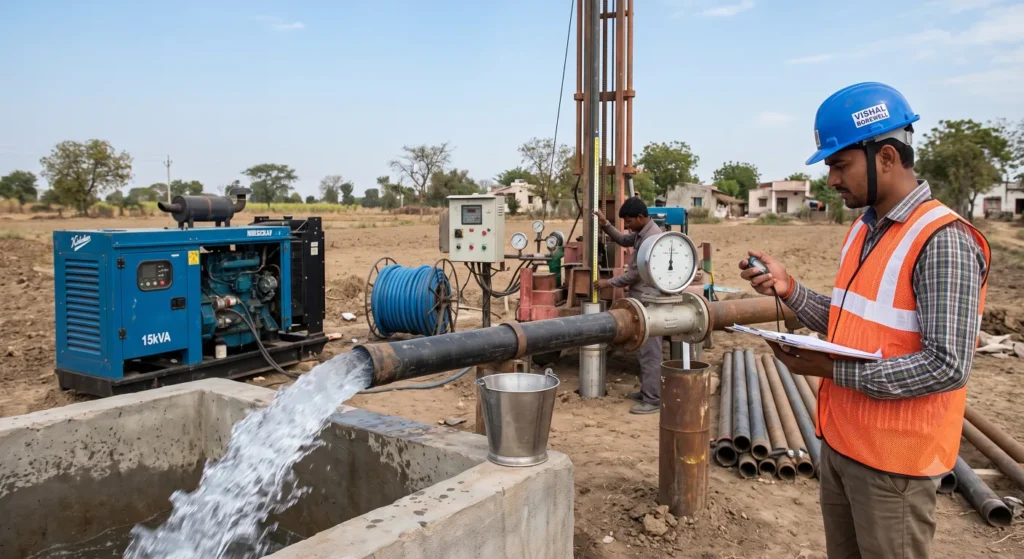
A borewell yield test is one of the most important procedures after drilling a borewell. It determines how much water a borewell can sustainably produce without over-extracting groundwater.
Whether you are installing a borewell for agriculture, industrial use, commercial buildings, residential projects, rainwater harvesting systems, or government compliance, conducting a professional yield test ensures your borewell performs efficiently for years.
At Vishal Borewell Drilling Service, we perform scientific borewell yield testing using professional equipment across Gujarat for agricultural, industrial, residential, and commercial clients.
What is a Borewell Yield Test?
A borewell yield test is a scientific pumping test performed to determine:
- Sustainable water discharge
- Groundwater availability
- Pumping capacity
- Aquifer performance
- Drawdown characteristics
- Recovery rate
- Safe pumping duration
The test identifies how much water can be continuously pumped without damaging the borewell or exhausting the aquifer.
Why is Borewell Yield Testing Important?
Many borewells initially produce large quantities of water but fail after installing the pump because the actual sustainable yield was never measured.
A professional yield test helps:
- Prevent dry running of pumps
- Select correct HP submersible pump
- Determine pump installation depth
- Prevent groundwater over-extraction
- Improve borewell lifespan
- Reduce electricity consumption
- Plan irrigation systems
- Design industrial water supply
Objectives of Borewell Yield Testing
The primary objectives include:
- Measure sustainable discharge
- Estimate aquifer capacity
- Determine groundwater recharge
- Measure drawdown
- Measure recovery rate
- Select proper pump capacity
- Avoid over pumping
- Prepare technical groundwater reports
When Should a Yield Test Be Conducted?
A borewell yield test should ideally be performed:
Immediately after drilling
This determines the initial groundwater availability.
Before installing a submersible pump
Ensures correct pump selection.
Before industrial operation
Industries require reliable discharge data.
For CGWA compliance
Many groundwater applications require pumping test reports.
During groundwater investigation
Used in hydrogeological studies.
Equipment Used for Borewell Yield Test
Professional testing generally requires:
- Submersible Test Pump
- Generator or Power Supply
- Water Flow Meter
- Digital Water Level Indicator
- Measuring Tape
- Pressure Gauge
- Stop Watch
- Discharge Pipe
- Control Valve
- Recording Sheet
- Data Logger (Optional)
- Telemetry Monitoring System (Optional)
Borewell Yield Test Procedure
Step 1 – Measure Static Water Level
Before pumping starts, the natural groundwater level inside the borewell is measured.
This is called the Static Water Level (SWL).
Example:
Ground Level → 0 ft
Water Level → 65 ft
Static Water Level = 65 feet
Step 2 – Install Test Pump
A temporary test pump is lowered inside the borewell.
Pump depth depends upon:
- Borewell depth
- Water column
- Aquifer location
Step 3 – Start Pumping
Water is pumped at a constant discharge.
Flow is measured continuously.
Step 4 – Record Water Level
Measurements are taken at regular intervals:
- 1 minute
- 2 minutes
- 5 minutes
- 10 minutes
- 20 minutes
- 30 minutes
- 1 hour
- 2 hours
- 4 hours
- 6 hours
Step 5 – Measure Drawdown
As pumping continues, water level drops.
This drop is called Drawdown.
Example:
Static Water Level = 65 ft
Dynamic Water Level = 115 ft
Drawdown = 50 ft
Step 6 – Stop Pumping
After required testing duration:
Pump is stopped.
Recovery measurements begin.
Step 7 – Recovery Test
Water level is monitored until it returns close to the original static level.
A faster recovery indicates:
- Good aquifer recharge
- Better groundwater availability
Static Water Level (SWL)
Static Water Level means:
Distance from ground surface to water before pumping.
It indicates:
- Natural groundwater condition
- Aquifer status
Dynamic Water Level (DWL)
Dynamic Water Level is measured while pumping.
It represents:
The water level under pumping conditions.
What is Drawdown?
Drawdown =
Dynamic Water Level
Minus
Static Water Level
Large drawdown indicates:
- Low yielding formation
- Excessive pumping
- Poor recharge
Recovery Test
Recovery test measures:
How quickly groundwater returns after pumping stops.
Fast recovery indicates:
- Healthy aquifer
- Good recharge
- Sustainable pumping
Step Drawdown Test
The pump is operated at different discharge rates.
Example:
Step 1 → 10 LPM
Step 2 → 20 LPM
Step 3 → 30 LPM
Step 4 → 40 LPM
Each step runs for fixed duration.
Results determine optimum pumping rate.
Constant Rate Pumping Test
Pump operates continuously at one discharge.
Usually performed for:
- 6 Hours
- 8 Hours
- 12 Hours
- 24 Hours
- 48 Hours
Long-duration tests provide the most reliable yield data.
Borewell Yield Calculation
Yield is generally expressed as:
- Litres per Minute (LPM)
- Cubic Meter per Hour (m³/hr)
- Gallons per Minute (GPM)
Example
Discharge:
35 LPM
Continuous Pumping:
6 Hours
Recovery:
Excellent
Sustainable Yield:
Approximately 35 LPM
Factors Affecting Borewell Yield
Several geological and environmental factors influence borewell performance:
Geological Formation
- Basalt
- Granite
- Sandstone
- Limestone
Borewell Diameter
Larger diameters can store more water but do not necessarily increase recharge.
Borewell Depth
Greater depth may intersect additional water-bearing fractures.
Aquifer Characteristics
Highly fractured aquifers typically provide higher yields.
Seasonal Variation
Water levels generally rise after the monsoon and decline during summer.
Rainfall
Good rainfall improves groundwater recharge.
Pump Capacity
An oversized pump can overdraw the aquifer, while an undersized pump may not utilize the borewell efficiently.
Typical Borewell Yield Categories
| Yield | Classification | Suitable Applications |
|---|---|---|
| Less than 10 LPM | Poor | Domestic backup |
| 10–30 LPM | Moderate | Small homes, farms |
| 30–60 LPM | Good | Agriculture, residential complexes |
| 60–100 LPM | Very Good | Commercial use |
| Above 100 LPM | Excellent | Industrial and municipal supply |
Actual yield depends on local geology and hydrogeological conditions.
Common Problems Found During Yield Testing
- Excessive drawdown
- Sand pumping
- Muddy water
- Pump cavitation
- Borewell collapse
- Low recharge
- Air entry into the pump
- Dry borewell conditions
- Declining water levels
How to Improve Borewell Yield
Professional measures to improve long-term performance include:
- Borewell flushing and development
- Air compressor cleaning
- Hydro-fracturing (where suitable)
- Rainwater harvesting and recharge wells
- Recharge pit installation
- Proper submersible pump sizing
- Borewell rehabilitation
- Regular maintenance and monitoring
Borewell Yield Test Report
A professional yield test report generally includes:
- Client information
- Borewell location
- Borewell depth
- Casing details
- Drilling method
- Static water level
- Dynamic water level
- Drawdown
- Pump details
- Discharge rate
- Recovery observations
- Test duration
- Geological formations encountered
- Yield analysis
- Recommendations for pump selection
- Photographs (if required)
This report is valuable for project documentation, engineering decisions, and regulatory compliance.
Why Choose Vishal Borewell Drilling Service?
With over 40 years of experience and 8,000+ successfully completed borewell projects, Vishal Borewell Drilling Service provides reliable groundwater solutions across Gujarat.
Our Services
- Borewell Drilling
- Borewell Yield Testing
- Pumping Tests
- Groundwater Investigation
- Hydrogeological Survey
- Electrical Resistivity Survey
- Rainwater Harvesting Systems
- Recharge Well Construction
- Borewell Rehabilitation
- Borewell Cleaning & Flushing
- Submersible Pump Installation
- Piezometer Installation
- Digital Water Level Recorder (DWLR)
- Electromagnetic Flow Meter Installation
- CGWA NOC Consultancy
Frequently Asked Questions (FAQs)
How long does a borewell yield test take?
Depending on project requirements, tests may last from 2 hours to 24 hours, with longer tests providing more reliable data.
What is considered a good borewell yield?
A sustainable yield of 30–60 LPM is generally suitable for many agricultural and residential applications, though requirements vary by usage.
Can yield testing prevent pump failure?
Yes. It helps select the correct pump capacity and installation depth, reducing the risk of dry running and premature pump damage.
Does borewell depth guarantee higher yield?
No. Yield depends primarily on the aquifer’s characteristics and water-bearing fractures, not just depth.
Is a yield test required for industrial projects?
Many industrial projects, environmental studies, and groundwater compliance processes require a documented pumping or yield test.
Conclusion
A borewell yield test is essential for understanding the sustainable capacity of a borewell and ensuring efficient groundwater use. By measuring discharge, drawdown, and recovery, property owners can make informed decisions about pump selection, irrigation planning, industrial water supply, and long-term borewell management.
Professional testing not only protects your investment but also supports responsible groundwater conservation.