
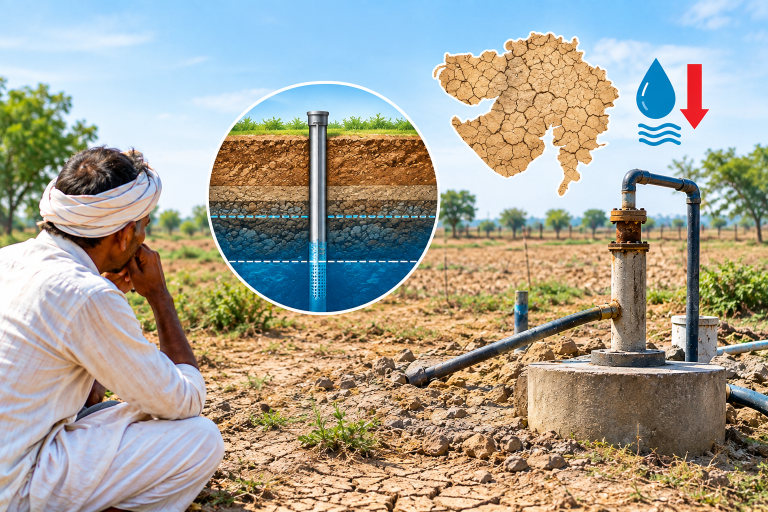
Falling Groundwater Levels in Gujarat: Borewell Solutions & What to Do
Groundwater is one of Gujarat’s most important water resources for agriculture, industries, commercial properties and residential development. But when groundwater levels decline, an existing borewell can gradually lose its ability to provide a reliable water supply.
For borewell owners in areas such as Vadodara, Waghodia, Savli, Jarod, Halol and surrounding parts of Gujarat, understanding groundwater conditions is becoming increasingly important.
According to the Central Ground Water Board (CGWB) Dynamic Ground Water Resources of Gujarat 2024 assessment, Gujarat had an estimated annual extractable groundwater resource of 25.58 billion cubic metres, while annual groundwater extraction was estimated at 13.86 billion cubic metres, representing an overall stage of groundwater extraction of 54.21%. The assessment classified 22 of 252 assessment units as over-exploited, 10 as critical and 24 as semi-critical. (Central Ground Water Board)
These figures do not mean that every borewell in Gujarat is at risk. Groundwater conditions can vary significantly from one location to another because of geology, rainfall, recharge, groundwater use and aquifer characteristics. CGWB also monitors groundwater levels regionally and evaluates long-term trends. (Central Ground Water Board)
So, what does falling groundwater actually mean for your borewell?
What Is Groundwater Level?
Groundwater is water stored beneath the ground in pores, fractures and geological formations called aquifers.
The groundwater level is commonly measured as the depth below ground level (mbgl) at which water is encountered.
For example:
Groundwater at 50 ft below ground level → relatively shallow water level
Groundwater at 150 ft → deeper water level
Groundwater at 300 ft → significantly deeper water level
However, a deeper water level does not automatically mean that a borewell will fail. The availability and sustainable yield of a borewell depend on the aquifer, fractures, recharge conditions, well construction and pumping characteristics.
CGWB notes that groundwater levels depend on factors including hydrogeological conditions, recharge and groundwater extraction. (Central Ground Water Board)
Why Are Groundwater Levels Falling in Gujarat?
Several factors can contribute to groundwater decline.
1. Increasing Groundwater Extraction
Agriculture, industries, commercial establishments and other users may depend heavily on groundwater.
When groundwater withdrawal consistently exceeds recharge in a local aquifer, water levels can decline.
2. Irregular Rainfall
Rainfall is one of the major natural sources of groundwater recharge.
Heavy rainfall concentrated over a short period may generate surface runoff rather than allowing sufficient water to infiltrate into the ground.
3. Reduced Groundwater Recharge
Rapid urbanization can increase paved surfaces such as:
Roads
Concrete areas
Industrial premises
Parking areas
Buildings
These surfaces can reduce natural infiltration.
4. Increased Water Demand
Population growth, industrial development and agricultural requirements can increase pressure on groundwater resources.
5. Local Geological Conditions
Two borewells located only a few kilometres apart can sometimes produce very different results because underground geological formations are not uniform.
This is particularly important in hard-rock areas where groundwater may be concentrated in fractures and weathered zones.
What Happens to Your Borewell When Groundwater Levels Fall?
A declining groundwater level can affect an existing borewell in several ways.
1. Reduced Water Yield
One of the first warning signs may be a reduction in the quantity of water available from the borewell.
You may notice that a borewell that previously supplied sufficient water is now producing less.
2. Longer Pumping Time
The pump may need to operate for longer periods to provide the same amount of water.
This can increase:
Electricity consumption
Pump operating hours
Equipment wear
Maintenance requirements
3. Pump Dry Running Risk
If the pumping water level falls below the effective operating range of the pump, the pump may experience insufficient water around the intake.
Dry running can cause serious damage to a submersible pump.
Therefore, pump selection and installation should consider actual groundwater conditions rather than simply relying on the borewell depth.
4. Increased Borewell Depth Requirements
When planning a new borewell, declining groundwater levels may require deeper exploration to identify productive water-bearing formations.
However, simply drilling deeper is not a guarantee of water.
A professional assessment of local geology and groundwater conditions can help improve decision-making.
5. Water Quality May Change
Changes in groundwater conditions can sometimes affect water quality.
Depending on local geology and groundwater conditions, users may encounter issues such as:
High TDS
Hardness
Iron
Fluoride
Salinity
Other chemical parameters
Therefore, groundwater quantity and groundwater quality should both be considered when evaluating a borewell.
Does a Deeper Borewell Always Solve the Problem?
No.
This is one of the most important points for borewell owners.
If an existing borewell is producing less water, drilling deeper without understanding the underlying geological conditions may not provide the expected result.
A successful borewell depends on finding a productive water-bearing formation, not simply increasing depth.
Before deciding to deepen or drill a new borewell, consider:
Existing borewell depth
Static water level
Pumping water level
Historical water yield
Local geology
Nearby borewell performance
Groundwater recharge
Seasonal variations
Water quality
Required water demand
What Should You Do If Your Borewell Yield Is Falling?
If you notice that your borewell is producing less water, take action before the problem becomes severe.
Step 1: Check the Water Level
Measure the groundwater level periodically.
Monitoring the static and pumping water levels can help identify whether the problem is related to groundwater decline or another borewell/pump issue.
Step 2: Check Your Submersible Pump
Reduced water output does not always mean that groundwater has disappeared.
Possible causes can include:
Pump wear
Pump blockage
Electrical problems
Damaged rising pipes
Reduced pump efficiency
Borewell clogging
Sand production
A proper inspection can help identify the actual cause.
Step 3: Consider Borewell Cleaning and Rehabilitation
Over time, borewells can experience clogging, mineral deposition, sediment accumulation or reduced formation permeability.
In suitable cases, borewell cleaning and rehabilitation may help restore performance.
This should be evaluated based on the actual condition of the borewell.
Step 4: Evaluate the Need for Deepening
If geological and technical information indicates that deeper productive formations may exist, borewell deepening can be considered.
However, this decision should be based on professional assessment rather than guesswork.
Groundwater Exploration Before Drilling a New Borewell
If you are planning a new borewell for an industrial, agricultural, residential or commercial requirement, groundwater exploration can help improve site selection.
Depending on site conditions, professional groundwater assessment may involve:
Hydrogeological Survey
A hydrogeological study evaluates the geological and groundwater characteristics of the area.
Electrical Resistivity Survey
Electrical resistivity techniques can be used to investigate subsurface formations and identify zones that may have groundwater potential.
Local Borewell Data
Information from nearby existing borewells can provide useful supporting evidence regarding:
Depth
Yield
Water level
Geological formation
Seasonal performance
The objective is to make a better-informed drilling decision, rather than guaranteeing groundwater at a particular depth.
Rainwater Harvesting: A Long-Term Response to Groundwater Decline
One of the most effective ways to reduce pressure on groundwater resources is to improve rainwater harvesting and groundwater recharge.
Instead of allowing rainwater to rapidly run off a property, suitable systems can collect and direct water toward appropriate recharge structures.
Possible approaches include:
Rooftop rainwater harvesting
Recharge pits
Recharge wells
Stormwater management
Percolation structures
Groundwater recharge systems
The correct system depends on the site’s soil, geology, rainfall, available area and groundwater conditions.
For industries and large properties, integrating rainwater harvesting with groundwater management can be particularly valuable.
Borewell Management for Industries in Gujarat
Industrial groundwater users should look beyond simply drilling a borewell.
A proper groundwater management strategy can include:
Groundwater Exploration → Borewell Design → Pump Selection → Water-Level Monitoring → Flow Measurement → Recharge → Regulatory Compliance
For groundwater-dependent industries, monitoring consumption and groundwater levels can help identify problems early.
Where applicable, groundwater abstraction may also involve regulatory requirements and CGWA NOC/groundwater compliance. CGWA’s current regulatory guidance includes requirements related to hydrogeological studies and impact assessment for certain groundwater extraction projects depending on the assessment category and extraction quantity. (Central Ground Water Board)
What Borewell Owners in Vadodara and Nearby Areas Should Watch
If you operate a borewell in Vadodara, Waghodia, Savli, Jarod, Halol or nearby industrial and agricultural areas, keep an eye on these warning signs:
⚠️ Warning Signs
Borewell water output is decreasing
Water level is falling faster than before
Pumping time is increasing
Pump frequently runs without adequate water
Water quality has changed
Sand or sediment is appearing
Pump performance has reduced
Borewell recovery after pumping is becoming slower
These signs do not necessarily mean the borewell has failed. A technical inspection can help determine the actual cause.
How Vishal Borewell Can Help
Vishal Borewell Drilling Service, Vadodara provides groundwater and borewell solutions for agricultural, industrial, commercial and other requirements.
With 40+ years of experience and 8,000+ successful borewell projects, our services include:
Borewell Drilling
DTH & DR Drilling
Industrial Borewells
Agricultural Borewells
Groundwater Exploration
Hydrogeological Surveys
Electrical Resistivity Surveys
Borewell Cleaning & Rehabilitation
Submersible Pump Solutions
Rainwater Harvesting Consultancy
Groundwater Monitoring Solutions
Electromagnetic Flow Meters with IoT
Piezometer & DWLR Telemetry Solutions
CGWA NOC & Groundwater Compliance Consultancy
Our objective is not simply to drill deeper—it is to help customers make better groundwater decisions based on site conditions, technical assessment and long-term water requirements.
The Future of Borewell Management Is Groundwater Management
A borewell should not be treated as an unlimited source of water.
As groundwater conditions change, responsible water management becomes increasingly important.
For a new borewell, the right approach is:
Assess → Explore → Drill → Test → Monitor → Recharge → Manage
For an existing borewell:
Monitor → Diagnose → Maintain → Optimize → Recharge
This approach can help extend borewell usefulness, reduce unnecessary expenditure and support more sustainable groundwater use.
Conclusion
Falling groundwater levels can affect borewell yield, pumping costs, equipment performance and long-term water security.
But a decline in borewell performance does not automatically mean that you need to drill a completely new borewell.
The first step should be to understand what is happening underground.
Professional groundwater exploration, water-level monitoring, borewell inspection, rehabilitation, efficient pumping and rainwater harvesting can all play an important role in managing groundwater responsibly.
For borewell requirements in Vadodara, Jarod, Savli, Waghodia, Halol and across Gujarat, consult an experienced groundwater professional before making major drilling or deepening decisions.
Need help with a new borewell or an existing borewell with declining yield?
Vishal Borewell Drilling Service
📍 Vadodara, Gujarat
📞 +91 84698 77021
🌐 vishalborewell.com
Precision. Sustainability. Trust.