
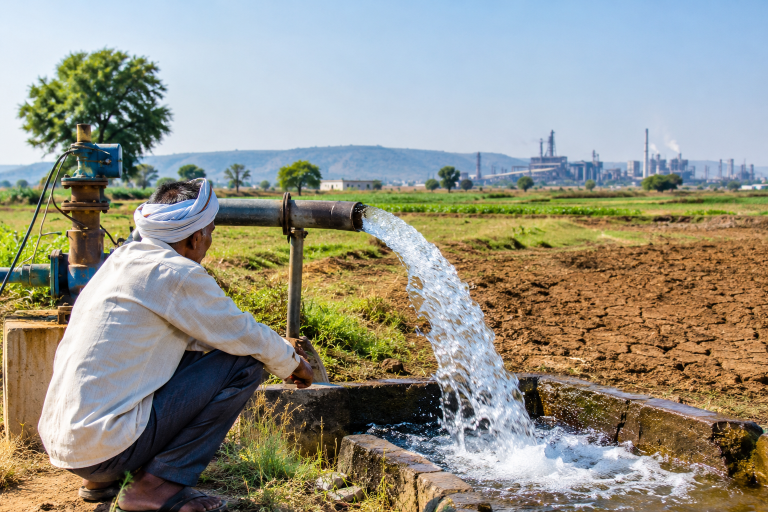
Is Gujarat Facing a Groundwater Challenge After the 2026 Monsoon?
Groundwater is one of the most important natural resources supporting agriculture, industries, commercial establishments and households across Gujarat. When the monsoon is weak, irregular or unevenly distributed, groundwater recharge can suffer, increasing pressure on existing wells and borewells.
The 2026 monsoon highlighted an important distinction between total rainfall and its distribution. Gujarat experienced considerable regional variation. On September 30, 2026, reported state rainfall stood at approximately 89.16% of normal, while several districts experienced significant deficits and others received excess rainfall. This means that statewide averages alone cannot establish whether a particular village, industrial estate or borewell location has sufficient groundwater.
For the Vadodara region, including Jarod, Halol, Savli and Waghodia, the key question is not simply how much rain fell. It is how much water infiltrated the ground, replenished the aquifers and remained available after agricultural, industrial and domestic extraction.
The Central Ground Water Board (CGWB) has published groundwater assessment and aquifer-mapping reports for Vadodara district. These reports provide an important scientific foundation for understanding local groundwater conditions and planning artificial recharge.
The central message is clear: after an uneven monsoon, groundwater should be assessed, conserved and managed scientifically rather than relying on assumptions about water availability.
1. Understanding the 2026 Monsoon Situation in Gujarat
The southwest monsoon generally supplies a substantial share of the annual rainfall that replenishes groundwater across Gujarat. However, seasonal rainfall totals can hide differences in rainfall timing, intensity and location.
An August 2026 report in The Times of India described Gujarat’s rainfall pattern as highly uneven, highlighting the contrast between regions receiving substantial rainfall and areas experiencing deficits. Subsequent reporting by The Indian Express on October 2, 2026, confirmed that Gujarat’s statewide rainfall had reached approximately 89.16% of normal by September 30, with major differences among districts.
These observations matter because groundwater recharge is influenced by several factors:
The total rainfall received in a particular location.
The number and spacing of rainy days.
Rainfall intensity and the amount of surface runoff.
Soil permeability and geological formations.
Existing groundwater levels and available underground storage.
Groundwater pumping for agriculture, industrial processes and domestic use.
For example, a short, intense rainfall event may produce substantial runoff without replenishing groundwater as effectively as several moderate rainfall events that allow more water to infiltrate.
Similarly, a location receiving close to normal rainfall may still face groundwater stress if extraction is high or the underlying geological formation has limited storage capacity.
Important distinction: A below-normal or irregular monsoon increases the risk of inadequate recharge, but it does not prove that every borewell in Vadodara or its surrounding areas will experience a declining water level. Actual conditions must be assessed locally.
2. How a Weak Monsoon Affects Groundwater
Groundwater is replenished when rainwater and other surface water sources infiltrate the soil and reach underground water-bearing formations called aquifers.
When rainfall is insufficient, several effects may occur.
2.1 Reduced groundwater recharge
Less effective rainfall can mean less water entering the ground. If recharge falls while pumping continues at normal or increased levels, the balance between replenishment and extraction becomes less favourable.
This can reduce groundwater storage and increase pressure on existing water sources.
2.2 Falling water levels in wells and borewells
A groundwater level may decline when water is withdrawn faster than it is replenished locally. The amount of decline varies with the aquifer, pumping intensity, surrounding wells and seasonal conditions.
A borewell that supplied adequate water during the monsoon may deliver less water during the dry season if its connected water-bearing fractures or aquifer experience declining pressure or available storage.
However, a reduced discharge can also result from pump damage, blockage, mineral deposits, sand entry or other mechanical problems. A proper diagnosis is essential before deciding that the groundwater level has fallen.
2.3 Higher pumping costs
As the pumping water level falls, some installations may need greater energy to lift water. Longer operating hours, inefficient pumps and unsuitable equipment can increase electricity consumption and maintenance costs.
The impact depends on the actual pumping level, pump efficiency, discharge requirements and installation design.
2.4 Greater pressure on existing groundwater resources
During dry periods, farmers, factories and households may increase their reliance on groundwater. If many users draw from the same aquifer, competition for the available resource can intensify.
This makes groundwater monitoring, demand management and recharge planning particularly important.
2.5 Groundwater quality concerns
Groundwater quantity and groundwater quality are separate issues. A declining water level does not automatically mean that the water has become unsafe.
Nevertheless, changes in groundwater flow, excessive pumping or local contamination can affect water quality. Salinity, fluoride, nitrate, iron and other parameters should be evaluated according to local geology and potential contamination sources.
Drinking water should be tested through a competent laboratory before being considered safe for consumption.
3. Geographic Analysis: Vadodara, Jarod, Halol, Savli and Waghodia
The following assessment combines published regional hydrogeological information with practical risk factors. It is not a measurement of current groundwater levels at individual sites.
3.1 Vadodara: Urban Growth and Multiple Water Demands
Vadodara combines residential neighbourhoods, commercial areas, industrial facilities and surrounding agricultural land. Groundwater conditions vary between the alluvial formations and other geological units encountered across the wider district.
The CGWB’s Aquifer Mapping and Management of Ground Water Resources: Vadodara District, Gujarat report discusses the district’s aquifers and potential groundwater-management interventions.
Potential risks after an uneven monsoon include:
Increased dependence on borewells during periods of limited surface-water availability.
Greater competition between domestic, commercial and industrial users.
Seasonal declines in groundwater levels in heavily pumped localities.
Inadequate recharge where paved surfaces prevent infiltration.
Higher pumping and maintenance expenses for poorly designed installations.
Recommended approach: Residential societies, commercial establishments and factories should measure borewell discharge, track pumping hours, check water quality and identify feasible rooftop rainwater harvesting or recharge opportunities.
Urban rainwater harvesting can help reduce runoff and improve local recharge where suitable geological conditions and water quality permit.
3.2 Jarod: Agricultural Demand and Local Groundwater Variability
Jarod and its surrounding rural areas have agricultural, residential and commercial water requirements. The nearby geological conditions and water-bearing formations can vary from one property to another.
Agricultural pumping can become particularly important when soil moisture is insufficient and crops require additional irrigation.
Potential concerns include:
Greater irrigation requirements during dry spells.
Increased operating hours for agricultural pumps.
Reduced reliability of individual wells where replenishment is limited.
Competition between agricultural and other local water users.
Higher costs when pumping equipment is inefficient.
Recommended approach: Farmers should assess the actual discharge of their existing borewell, review seasonal water requirements and use drip or sprinkler irrigation where appropriate. Farm ponds, field bunds and suitable recharge structures can help capture runoff.
A new borewell should be planned only after reviewing nearby well records, local geology, groundwater conditions and the intended pumping requirement.
3.3 Halol: Industrial Reliability and Hard-Rock Groundwater
Halol, in Panchmahal district, has industrial and residential water requirements alongside surrounding agricultural demand.
Groundwater prospects in parts of this wider region may be influenced by hard-rock formations, including basaltic terrain. In such settings, groundwater commonly occurs in weathered zones, joints, fractures and other water-bearing features rather than being uniformly distributed throughout the rock.
Consequently, two nearby borewells may have very different yields.
Potential concerns include:
Uncertain borewell yield where productive fractures are limited.
Rising operating costs if pumping levels decline.
Production interruptions when a facility depends on a single water source.
Inadequate water storage during maintenance or supply disruptions.
Water-quality variations that affect industrial processes.
Recommended approach: Industrial facilities should establish a water-demand baseline, investigate alternative or supplementary supplies, maintain emergency storage and monitor existing borewell performance.
A hydrogeological investigation can help identify favourable drilling locations, but no survey method can guarantee that a proposed borewell will produce a particular quantity of water.
3.4 Savli: Industrial Estates, Agriculture and Shared Groundwater Pressure
Savli and its surrounding industrial and agricultural areas require careful water-resource planning.
The CGWB’s Vadodara district groundwater documentation identifies basalt as the principal aquifer category for Savli in its artificial-recharge assessment. This is a useful regional reference, although individual sites may encounter different formations or local aquifer conditions.
Savli’s water-management priorities include:
Reliable water for industrial operations.
Irrigation for agricultural land.
Domestic requirements in residential settlements.
Managing demand from multiple users drawing on groundwater.
Identifying locations suitable for rainwater harvesting and artificial recharge.
The CGWB’s aquifer-mapping report identifies Savli among the district’s areas considered for artificial-recharge planning. This supports investigating recharge opportunities rather than assuming that deeper drilling alone is the best response.
Recommended approach: Factories should measure water consumption, evaluate process-water recycling, capture suitable rooftop runoff and investigate recharge structures based on site conditions. Farmers should improve irrigation efficiency and avoid unnecessary pumping.
3.5 Waghodia: Variable Aquifers and Agricultural Water Security
Waghodia includes agricultural, residential and industrial areas with potentially different groundwater requirements and geological conditions.
The CGWB’s district documentation identifies basalt in its artificial-recharge assessment for Waghodia. However, groundwater availability can vary significantly between individual locations depending on weathering, fractures, aquifer connectivity and local extraction.
Jarod and Waghodia should therefore not be treated as having identical groundwater conditions simply because they are geographically close.
Potential risks include:
Reduced recharge during a deficient or irregular monsoon.
Higher agricultural demand during dry spells.
Variable borewell yield between properties.
Increased dependence on pumping during the dry season.
Insufficient storage or recharge infrastructure.
Recommended approach: Monitor water levels and discharge, investigate suitable recharge locations and improve irrigation efficiency. Existing borewells should be evaluated before undertaking deepening or replacement work.
4. What Does the Geological Condition Mean for Borewell Planning?
Geology plays a major role in determining how groundwater is stored and transmitted.
In alluvial formations, groundwater may occur within permeable sand, gravel and other sedimentary layers. In hard-rock areas, groundwater may depend more strongly on weathered zones, joints and fractures.
This distinction affects the way a borewell should be investigated and constructed.
| Factor | Alluvial formations | Hard-rock formations |
|---|---|---|
| Common water-bearing features | Permeable sand and gravel layers | Weathered zones, joints and fractures |
| Important investigation | Aquifer layers and their thickness | Fracture zones and weathered rock |
| Key drilling concern | Suitable aquifer selection and well construction | Locating productive water-bearing zones |
| Recharge consideration | Permeability and aquifer connectivity | Suitable fractures and weathered zones |
| Yield certainty | Requires site-specific assessment | Requires site-specific assessment |
These are general hydrogeological distinctions, not a substitute for a geological survey.
A groundwater survey can improve drilling decisions, particularly when combined with local borewell records and professional interpretation. Methods such as electrical resistivity surveys can help investigate subsurface variations, but they cannot guarantee water availability, water quality or a particular yield.
5. Impact of Groundwater Shortages on Agriculture
Agriculture is highly sensitive to the availability and timing of irrigation water.
If rainfall is inadequate and groundwater recharge is limited, farmers may need to increase irrigation when crops are already experiencing moisture stress.
Main agricultural risks
Reduced soil moisture and crop stress.
Higher electricity or diesel costs for pumping.
Increased pressure on existing wells and borewells.
Difficulty meeting peak irrigation requirements.
Lower crop productivity if water demand cannot be met.
Greater uncertainty in farm planning and input expenditure.
Practical solutions for farmers
1. Adopt drip or sprinkler irrigation. These systems can improve water-use efficiency when correctly designed, operated and maintained.
2. Schedule irrigation according to crop requirements. Avoid unnecessary watering and consider soil moisture, crop stage and weather conditions.
3. Capture rainwater. Farm ponds, field bunds and other suitable runoff-management structures can help store water for later use.
4. Improve groundwater recharge. Recharge pits, shafts or other structures should be selected according to local geology, soil conditions and water quality.
5. Maintain existing borewells. Inspect pumps, electrical components and discharge performance. Borewell cleaning or development may be appropriate where clogging or sediment is responsible for reduced performance.
6. Plan crops around water availability. Farmers should consider locally recommended crop varieties, crop duration and seasonal water requirements.
A deeper borewell is not automatically the correct solution to agricultural water stress. Improving efficiency and understanding the existing groundwater source may be more sustainable and economical.
6. How Groundwater Stress Can Affect Industries
Reliable water is essential for manufacturing, cleaning, cooling, boilers, utilities, sanitation and other industrial operations.
Industries in and around Vadodara, Savli and Halol may face different water requirements depending on their processes. The consequences of unreliable water supply can therefore range from higher operating expenses to production interruptions.
Potential effects on industrial operations
Production interruptions: A water-dependent production line may need to slow down or stop if its supply becomes inadequate.
Higher operating costs: Increased pumping, emergency water purchases, additional storage and equipment maintenance can raise operating expenses.
Cooling-system challenges: Facilities using water for cooling must manage supply reliability and maintain appropriate water treatment.
Boiler and process-water requirements: Water quality and treatment are essential for many industrial systems. Changes in water chemistry may increase treatment requirements.
Sanitation and employee welfare: Factories must continue providing appropriate water for sanitation, cleaning and employee needs.
Business continuity risks: Facilities dependent on a single borewell or supply source may be more vulnerable to equipment failures or seasonal water shortages.
Recommended industrial water-management plan
Measure water consumption by process, shift or department.
Monitor borewell water levels, discharge and pumping hours.
Check pump efficiency and repair leaks.
Reuse treated wastewater where permitted and technically suitable.
Harvest suitable rooftop rainwater.
Investigate recharge opportunities where hydrogeological conditions permit.
Maintain sufficient storage for operational contingencies.
Develop a backup water-supply plan and review applicable permissions.
Test water quality according to industrial process requirements.
Review water performance periodically instead of waiting for a supply failure.
For many industries, reducing unnecessary water consumption and improving reliability may be more economical than relying exclusively on a new borewell.
7. Solutions for Domestic Water Security
Households, housing societies, schools, hospitals and commercial buildings also need dependable water supplies.
A weak monsoon may increase concern about borewell performance, particularly during the dry months that follow the rainy season.
Recommended measures include:
Repair leaking taps, pipelines and overhead tanks.
Install appropriate rooftop rainwater harvesting systems.
Monitor existing borewell discharge and water levels.
Maintain pumps and electrical control panels.
Investigate recharge structures where suitable.
Store water safely for essential uses.
Test drinking water through a competent laboratory.
Avoid excessive groundwater extraction.
Housing societies should distinguish between a temporary pump problem and an actual reduction in groundwater availability before deciding to replace or deepen a borewell.
8. Rainwater Harvesting and Artificial Groundwater Recharge
Rainwater harvesting is an important part of long-term groundwater management, particularly in areas where suitable land, rainfall runoff and geological conditions are available.
However, not every recharge structure is suitable for every site.
Rooftop rainwater harvesting
Rainwater from suitable roofs can be collected through gutters and downpipes, passed through appropriate filtration and directed to storage or a professionally designed recharge system.
Recharge pits and shafts
These structures can help direct suitable runoff into permeable underground formations. Their design depends on soil conditions, aquifer characteristics, available space and the intended recharge volume.
Recharge borewells
A recharge borewell may be appropriate at selected locations, but it requires careful design, suitable filtration and evaluation of water quality and the receiving aquifer.
Untreated or contaminated runoff should not be injected into groundwater. Recharge structures must be designed to reduce the risk of contaminating aquifers and should comply with applicable requirements.
Estimate the potential rooftop runoff
A preliminary rainwater-harvesting estimate can be calculated using:
Potential collected water (litres) = rainfall (mm) × roof area (m²) × runoff coefficient
For example, a 1,000 m² roof receiving 100 mm of rain, with an assumed runoff coefficient of 0.8, could theoretically collect:
100 × 1,000 × 0.8 = 80,000 litres
This is an illustrative calculation, not a forecast of actual groundwater recharge. Real collection depends on rainfall intensity, roof condition, filtration, conveyance losses and storage capacity.
9. How Vishal Borewell Can Help During Groundwater Stress
Vishal Borewell provides borewell drilling and related groundwater services for agricultural, residential and industrial requirements in Vadodara and surrounding areas.
When groundwater availability becomes uncertain, the objective should be to select an appropriate technical solution rather than simply drilling deeper.
Groundwater survey and drilling guidance
A site assessment and suitable groundwater investigation can help identify promising drilling locations and improve the planning process.
The geological conditions, available nearby borewell information and intended water demand should be reviewed before selecting a drilling method or proposed depth.
Borewell drilling
Vishal Borewell offers drilling approaches including Direct Rotary (DR), Down-the-Hole (DTH) and combined DR-DTH drilling, selected according to the ground conditions and project requirements.
Proper planning, suitable casing, appropriate construction practices and professional execution are important for the long-term performance of a borewell.
Borewell cleaning and development
Where a borewell has reduced discharge because of clogging, accumulated sediment or other remediable problems, suitable cleaning or well-development work may help restore performance.
The cause should be investigated first. Cleaning cannot create groundwater where the aquifer does not provide sufficient water.
Rainwater harvesting and recharge consultancy
Vishal Borewell can assist with evaluating rainwater-harvesting and recharge requirements, including suitable filtration and recharge arrangements based on site conditions.
The purpose is to help customers capture suitable runoff and improve local water management wherever feasible.
Pump and water-delivery consultancy
Correct pump selection should consider borewell depth, pumping water level, required discharge, total dynamic head, pipeline losses and electrical requirements.
An appropriately selected pump can improve operating efficiency and help avoid unnecessary energy consumption.
Industrial groundwater management
Industrial customers can evaluate borewell performance, pumping equipment, water storage, rainwater harvesting and recharge options as part of a wider water-management strategy.
Facilities requiring regulatory monitoring, groundwater permissions or specialised instrumentation should also assess their applicable compliance obligations.
Quality-focused workmanship
Vishal Borewell emphasises technical quality and workmanship rather than selecting a contractor solely on the lowest per-foot drilling price.
The company offers a lifetime workmanship warranty on drilling work, subject to the written warranty terms and exclusions. This should not be interpreted as a guarantee of groundwater availability, yield, level or quality, all of which depend on natural geological and hydrogeological conditions.
10. A Practical Water-Security Roadmap for 2026–2027
The period after the monsoon is a useful time to review water requirements and prepare for the next dry season.
Immediate actions
Measure the discharge of existing borewells.
Record pumping hours and operating costs.
Inspect pumps, pipelines and electrical equipment.
Check drinking-water and process-water quality.
Identify critical water requirements and backup arrangements.
Before the next monsoon
Review the property’s geological and groundwater information.
Assess rooftop rainwater harvesting opportunities.
Investigate suitable recharge locations.
Repair existing harvesting and drainage infrastructure.
Plan irrigation improvements and industrial water-reuse measures.
During the next monsoon
Capture suitable rainwater.
Maintain filters, gutters and recharge structures.
Monitor water levels and recharge performance.
Prevent contaminated runoff from entering recharge systems.
Record rainfall, pumping and water-use data to improve future decisions.
The most effective groundwater strategy combines responsible extraction, efficient water use, appropriate recharge and regular monitoring.
Frequently Asked Questions
1. Will groundwater levels fall in Vadodara after the weak 2026 monsoon?
Groundwater levels may decline in locations where recharge is inadequate relative to extraction. However, the effect will differ by locality and aquifer. Actual water levels must be measured before concluding that a particular borewell is affected.
2. Will existing borewells in Jarod and Waghodia stop supplying water?
Not necessarily. Borewell performance depends on the water-bearing formation, existing groundwater conditions, pumping demand and well construction. Some borewells may continue to perform normally, while others may experience reduced discharge.
3. Is a groundwater survey useful before drilling a new borewell?
Yes. A suitable hydrogeological investigation can help assess subsurface conditions and guide site selection. Its results must be interpreted alongside local geological information and nearby borewell records. No survey can guarantee a particular water yield.
4. Can rainwater harvesting improve groundwater availability?
Rainwater harvesting can help capture runoff and support groundwater recharge where the geological conditions, water quality and structure design are suitable. Its effectiveness depends on the amount of water captured and the receiving aquifer.
5. What should farmers do if their borewell discharge decreases?
First, check the pump, electrical supply, pipeline, discharge and pumping water level. If the problem is caused by clogging, appropriate cleaning may help. If groundwater availability has declined, the response may require demand management, irrigation improvements or a groundwater assessment.
6. How can factories in Savli and Halol prepare for water shortages?
Factories should monitor consumption, maintain pumps, reuse suitable treated wastewater, harvest rainwater, assess recharge options and establish backup supplies. Water-dependent processes should have contingency plans to reduce the risk of production interruptions.
7. Should a borewell be deepened immediately after a weak monsoon?
No. Deepening should not be the automatic first response. The existing well’s condition, pumping level, geological information and nearby groundwater data should be evaluated before deciding whether deepening, rehabilitation, a new well or demand management is appropriate.
8. Does drilling a deeper borewell guarantee more water?
No. Greater depth does not guarantee a productive aquifer. In hard-rock areas, yield may depend on specific fractures or weathered zones. In other formations, aquifer thickness, permeability and water quality also influence the result.
9. Is borewell water automatically safe for drinking?
No. Groundwater should be tested for relevant physical, chemical and microbiological parameters before being considered suitable for drinking. Water quality can vary between locations and over time.
10. How can Vishal Borewell help with groundwater challenges?
Vishal Borewell offers groundwater survey and drilling guidance, DR and DTH drilling, borewell cleaning and development, rainwater-harvesting consultancy and pump-related technical guidance. The appropriate service depends on the site’s geology, existing borewell condition and intended water requirements.
Conclusion: Plan Groundwater Use Before a Shortage Occurs
The uneven 2026 monsoon reinforces the importance of careful groundwater management across Vadodara, Jarod, Halol, Savli and Waghodia.
Agriculture needs reliable irrigation, industries need continuity of operations, and households need safe and dependable water. These requirements cannot be met sustainably through drilling alone.
A practical long-term strategy should combine groundwater investigation, technically appropriate borewell construction, responsible pumping, efficient water use, rainwater harvesting, suitable artificial recharge and regular monitoring.
Vishal Borewell encourages farmers, industries, developers and households to assess their water requirements and existing groundwater sources before investing in new infrastructure.
Plan scientifically. Use water responsibly. Invest in quality workmanship.
Vishal Borewell — Precision. Sustainability. Trust.
Technical note: This blog post provides general regional guidance, not a measured groundwater-level report for individual properties. Local groundwater levels, borewell yield and water quality require site-specific investigation and testing. Consult the relevant authorities for applicable groundwater extraction and recharge permissions.