
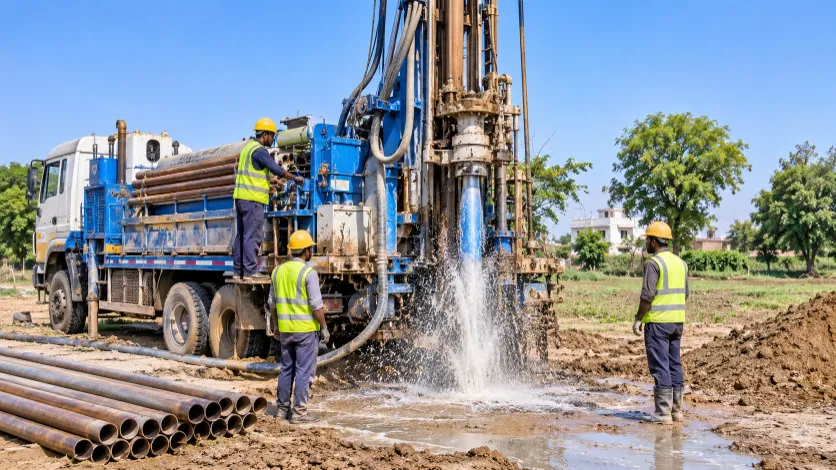
Understanding Borewell Drilling Technology
Groundwater is one of the most important natural resources for agriculture, industries, residential developments, commercial establishments and infrastructure projects. In regions where surface water is insufficient or unreliable, borewells provide access to underground aquifers for water supply.
However, successful borewell construction involves much more than drilling a hole into the ground. It requires geological understanding, hydrogeological investigation, appropriate drilling technology, proper borewell design, suitable casing materials, scientific construction practices and systematic testing.
A properly designed and constructed borewell can provide a dependable groundwater source for many years, subject to aquifer conditions, recharge and responsible pumping.
This Complete Borewell Drilling Technical Manual explains the entire process, from preliminary groundwater investigation to drilling, casing installation, gravel packing, borewell development, yield testing, pump selection and long-term maintenance.
The guide is prepared for Indian groundwater conditions, with particular relevance to Gujarat and surrounding regions.
1. What Is a Borewell?
A borewell is a narrow, deep vertical or inclined drilled structure constructed to access groundwater stored in underground geological formations.
Unlike an open well, which generally collects water from shallow formations, a borewell can penetrate deeper aquifers, including fractured hard-rock formations and porous sedimentary formations.
Groundwater enters the borewell through:
Natural fractures and joints in hard rocks.
Weathered and decomposed rock formations.
Sand and gravel aquifers.
Porous sedimentary layers.
Water-bearing geological formations.
The actual groundwater availability depends on the geology, aquifer characteristics, recharge conditions and surrounding groundwater extraction.
Important: Drilling deeper does not automatically guarantee more water. The objective should be to identify and access suitable water-bearing formations.
2. Preliminary Groundwater Investigation Before Drilling
Groundwater investigation is one of the most important stages of a successful borewell project.
Before mobilizing drilling machinery, the site should be evaluated to understand the probable geological formations and groundwater potential.
2.1 Geological Investigation
A geological investigation identifies the nature and distribution of underground formations.
Common geological formations encountered in Gujarat include:
Basalt and other hard-rock formations.
Weathered and fractured basalt.
Sandstone.
Limestone.
Alluvial sand and gravel.
Clay and silty formations.
Mixed sedimentary deposits.
Each geological formation requires a suitable drilling approach and borewell construction design.
2.2 Hydrogeological Survey
A hydrogeological survey evaluates the groundwater conditions of a proposed drilling location.
The investigation may include:
Study of regional geology.
Examination of nearby existing borewells.
Historical groundwater depth information.
Assessment of seasonal water-level variations.
Identification of probable aquifer zones.
Groundwater quality considerations.
Assessment of groundwater extraction and recharge conditions.
2.3 Electrical Resistivity Survey (ERT / VES)
Electrical resistivity methods are widely used for groundwater exploration.
The technique involves introducing electrical current into the ground through electrodes and measuring the resulting potential differences.
Different geological materials exhibit different electrical resistivity characteristics.
Typical applications include:
Identification of weathered zones.
Mapping of geological boundaries.
Identification of possible fractured formations.
Investigation of subsurface layering.
Selection of promising borewell locations.
The Vertical Electrical Sounding (VES) method investigates changes in apparent resistivity with increasing electrode spacing.
Electrical Resistivity Tomography (ERT) provides a two-dimensional or three-dimensional representation of subsurface resistivity distribution, depending on the survey configuration.
Important: Low resistivity does not always indicate groundwater. Clay, saline water and mineral-rich formations can also produce low resistivity readings. Geophysical interpretations should be correlated with local geology and borewell records.
2.4 Selection of the Final Drilling Location
The final location should be selected after considering:
Geophysical survey interpretation.
Geological conditions.
Nearby borewell performance.
Accessibility for drilling machinery.
Underground and overhead utilities.
Sanitation and contamination risks.
Applicable groundwater regulations.
A groundwater survey improves site-selection decisions but cannot guarantee water availability, quantity or quality.
3. Types of Borewell Drilling Methods
Different drilling technologies are used depending on the geological formation, required diameter, depth and project requirements.
The major drilling methods include:
3.1 Direct Rotary (DR) Drilling
<Add an image showing a direct rotary borewell drilling rig operating in soft soil formations.>
Direct Rotary Drilling is commonly used in unconsolidated and relatively soft geological formations.
In this method, a rotating drill bit cuts the formation while drilling fluid circulates through the drill string.
The drilling fluid performs several important functions:
Carries drilled cuttings towards the surface.
Cools and lubricates the drill bit.
Helps stabilize the borehole walls.
Maintains hydrostatic pressure.
Supports removal of drilling debris.
Major applications:
Alluvial formations.
Sand and clay formations.
Soft sedimentary formations.
Overburden drilling.
Large-diameter borewell construction.
3.2 Down-the-Hole Hammer (DTH) Drilling
<Add an image showing a DTH borewell drilling machine working in hard rock.>
DTH drilling is widely used for hard-rock formations.
In this technique, a pneumatic hammer is positioned near the drill bit at the bottom of the borehole.
Compressed air powers the hammer, which repeatedly strikes the rock while the drill string rotates.
The process breaks hard rock into smaller fragments, which are carried towards the surface by compressed air.
Major applications:
Basalt.
Granite.
Hard rock.
Fractured rock formations.
Deep agricultural and industrial borewells.
Advantages:
Effective rock penetration.
Suitable for hard formations.
Efficient removal of rock cuttings.
Helps identify water-bearing fractures during drilling.
3.3 Direct Rotary Cum DTH Drilling
This combined method uses Direct Rotary technology for soft overburden and DTH technology for hard-rock formations.
It is particularly useful where the subsurface geology contains multiple layers of different hardness.
Typical sequence:
Start drilling through soft overburden using the rotary method.
Stabilize the upper formation using suitable casing.
Change to DTH drilling when hard rock is encountered.
Continue drilling through the hard formation.
Record geological changes and water-bearing zones.
This method is particularly relevant to mixed geological conditions found across different parts of Gujarat.
3.4 Other Drilling Methods
Other technologies include:
Cable tool percussion drilling.
Mud rotary drilling.
Reverse circulation drilling.
Air rotary drilling.
Sonic drilling.
The selection depends on project objectives, geology, equipment availability and borewell design.
4. Borewell Drilling Machinery and Equipment
Professional borewell drilling requires suitable machinery and supporting equipment.
Major equipment
| Equipment | Primary function |
|---|---|
| Borewell drilling rig | Drilling operations |
| DTH hammer | Hard-rock penetration |
| Drill bit | Cutting and breaking formations |
| Drill rods | Transmit rotation and force |
| Air compressor | Powers DTH hammer and removes cuttings |
| Mud pump | Circulates drilling fluid |
| Casing pipes | Supports unstable formations |
| Welding equipment | Casing joint preparation where applicable |
| Measuring tools | Depth and borehole measurement |
| Lifting equipment | Handling pipes and accessories |
| Safety equipment | Personnel and site protection |
4.1 Air Compressor
An air compressor is an essential component of DTH drilling.
Compressed air is used to operate the pneumatic hammer and transport rock cuttings to the surface.
Compressor selection depends on:
Required air pressure.
Air delivery capacity (CFM).
Borewell depth.
Bore diameter.
Drill bit and hammer specifications.
Geological conditions.
An undersized compressor can reduce drilling efficiency and compromise cuttings removal.
5. Borewell Diameter and Drilling Size
Borewell diameter is selected according to the intended application, pump requirements, casing specifications and geological conditions.
Common borewell drilling sizes include:
4.5 inches.
5.5 inches.
6 inches.
6.5 inches.
7 inches.
8 inches.
10 inches and larger for specific applications.
The drilling diameter and casing diameter are not necessarily the same.
The final borewell design must consider:
Pump outer diameter.
Required annular clearance.
Casing and screen dimensions.
Gravel-pack thickness, where applicable.
Borehole stability.
Expected pumping capacity.
A larger borewell does not automatically produce more water. Aquifer characteristics are the primary determining factor.
6. Borewell Depth and Geological Formation
Borewell depth should be determined by geological investigation, nearby borewell information and actual drilling observations.
The following formations may be encountered during drilling:
| Formation | General characteristics |
|---|---|
| Topsoil | Loose surface material |
| Clay | Fine-grained, low-permeability formation |
| Sand | Granular formation with variable permeability |
| Gravel | Coarse granular formation |
| Weathered rock | Decomposed rock with variable water potential |
| Fractured rock | Rock containing joints and fractures |
| Massive hard rock | Relatively compact rock |
| Water-bearing zone | Formation transmitting groundwater |
6.1 Water Strike Identification
A water strike occurs when drilling intersects a water-bearing formation.
During drilling, the operator should record:
Depth of each water strike.
Geological formation at that depth.
Approximate water inflow.
Changes in drilling conditions.
Air-lift discharge observations.
Water quality observations, where possible.
Multiple water strikes may occur at different depths.
However, a water strike does not establish the sustainable pumping capacity of the borewell. Proper testing is necessary.
7. Borewell Casing Pipe Installation
Casing pipes are installed to support borewell walls and prevent collapse in unstable geological formations.
They also help isolate unsuitable formations and protect the borewell structure.
7.1 Types of Borewell Casing Pipes
Common casing materials include:
PVC casing pipes.
uPVC casing pipes.
Mild steel casing pipes.
Stainless steel casing pipes.
Other approved materials suitable for the application.
7.2 PVC Casing Pipe Classification
PVC pipes are available in different pressure classes and thickness specifications.
For example, 6 kg pressure-class PVC pipes may be selected for certain borewell applications depending on the manufacturer’s specifications and installation requirements.
The selection must consider:
Pipe outside diameter.
Wall thickness.
Material quality.
Joint strength.
Installation depth.
External formation pressure.
Groundwater chemistry.
Applicable product standards.
Always verify the manufacturer’s technical data and relevant Indian Standards before installation.
7.3 Plain Casing and Strainer Pipes
Plain casing pipe
Plain casing is used where water entry through the pipe wall is not required. It provides structural support and isolates unwanted formations.
Strainer pipe
Strainer pipes have openings that allow groundwater to enter the borewell while restricting the entry of formation particles.
Strainer selection depends on:
Aquifer grain-size distribution.
Formation permeability.
Desired entrance velocity.
Pumping requirements.
Gravel-pack design.
Incorrect screen-slot selection can result in sand entry, clogging and reduced borewell performance.
8. Gravel Packing in Borewell Construction
Gravel packing is used in suitable unconsolidated formations to improve the hydraulic performance of a borewell and reduce the movement of formation sand into the well.
Gravel is placed in the annular space between the borehole wall and the screen.
8.1 Purpose of Gravel Packing
Supports the formation around the screen.
Helps prevent fine sand entry.
Improves water movement towards the screen.
Reduces the risk of excessive sand production.
Supports long-term borewell performance when correctly designed.
8.2 Gravel Selection
Gravel selection should be based on aquifer grain-size analysis and screen-slot design.
Important considerations:
Grain-size distribution.
Particle shape.
Cleanliness.
Chemical compatibility.
Uniformity of material.
Appropriate gravel-pack thickness.
The use of random construction debris, ungraded gravel or contaminated material should be avoided.
Important: Gravel packing is not universally necessary for every borewell. Hard-rock DTH borewells and unconsolidated filter-packed tubewells have different construction requirements.
9. Borewell Drilling and Construction: Step-by-Step Process
A systematic construction process improves quality, safety and long-term performance.
Step 1: Site Inspection
Inspect the proposed location and confirm machinery access, site conditions and safety arrangements.
Step 2: Groundwater Investigation
Conduct geological assessment and, where appropriate, an electrical resistivity survey.
Step 3: Mobilization
Transport the drilling rig, compressor, drill rods, tools, casing materials and other necessary equipment.
Step 4: Initial Drilling
Start drilling according to the selected drilling method and borewell design.
Step 5: Geological Logging
Record geological formations, drilling progress and water strikes.
Step 6: Casing Installation
Install suitable casing pipes in unstable formations or where isolation is required.
Step 7: Screen Installation
Install appropriately designed screen sections across the target water-bearing formation in filter-packed borewells.
Step 8: Gravel Packing
Place the specified filter material in the annular space, where the design requires it.
Step 9: Borewell Development
Remove drilling fluids, fine particles and loose formation materials using suitable development techniques.
Step 10: Yield Testing
Measure discharge and water-level response using an appropriate pumping test.
Step 11: Pump Installation
Select and install a suitable submersible pump based on borewell construction and tested operating conditions.
Step 12: Final Documentation
Record the final depth, diameter, geological formations, casing details, water strikes and test results.
10. Borewell Cleaning and Development
Borewell development is an important process performed after drilling and construction.
Its purpose is to remove fine particles, drilling fluids and loose materials from the borewell and surrounding formation near the intake.
10.1 Air Compressor Cleaning
Compressed air is introduced through a suitable air pipe arrangement to lift water and suspended particles towards the surface.
This process is commonly known as air-lift cleaning or air development.
10.2 Benefits
Removes loose drilling cuttings.
Helps remove residual drilling fluids.
Reduces fine particle accumulation.
Improves the hydraulic connection between the borewell and surrounding formation.
Helps assess water inflow and discharge characteristics.
10.3 Important Precautions
Cleaning pressure and operating procedures must be appropriate for the borewell diameter, depth, casing strength and geological conditions.
Excessive pressure can damage casing or disturb unstable formations.
Professional cleaning should be performed using suitable compressor capacity and controlled operating procedures.
11. Borewell Yield Testing and Pumping Test
A borewell must be tested before selecting a permanent pump.
A successful water strike during drilling does not necessarily mean that the borewell can sustainably supply the required quantity of water.
11.1 Static Water Level
Static water level is the groundwater level measured in a borewell when it has recovered from pumping and is not being affected by active extraction.
11.2 Pumping Water Level
Pumping water level is the groundwater level measured while the borewell is being pumped.
11.3 Drawdown
Drawdown is the difference between the static water level and the pumping water level.
Formula:
Drawdown = Static Water Level − Pumping Water Level
11.4 Discharge Measurement
Water discharge can be measured using suitable flow-measuring instruments.
Common units include:
Litres per minute (LPM).
Litres per hour (LPH).
Cubic metres per hour (m³/hr).
Gallons per minute (GPM).
11.5 Specific Capacity
Specific capacity is the discharge divided by drawdown.
Specific Capacity = Q / s
Where:
Q = Pumping discharge
s = Drawdown
It is commonly expressed in LPM per metre of drawdown.
11.6 Pumping Test
A properly designed pumping test helps evaluate borewell performance.
It may include:
Measurement of static water level.
Controlled pumping at a known discharge.
Recording pumping water levels at specified intervals.
Measurement of discharge.
Observation of drawdown.
Recording recovery after pumping stops.
Longer-duration tests may be required for industrial and high-capacity applications.
The pumping test should be designed according to the project requirements and hydrogeological conditions.
12. Submersible Pump Selection and Installation
Selecting the correct submersible pump is essential for efficient borewell operation.
An incorrectly selected pump may cause excessive drawdown, increased energy consumption, frequent failures and unnecessary maintenance.
Important Selection Parameters
Required discharge.
Total dynamic head (TDH).
Static water level.
Pumping water level.
Delivery pipeline length.
Pipeline diameter.
Friction losses.
Elevation difference.
Motor power.
Available electrical supply.
Pump efficiency.
12.1 Total Dynamic Head
Total Dynamic Head represents the total energy head that the pump must provide to deliver water at the required discharge.
It generally includes:
Pumping water-level depth.
Elevation difference between delivery and discharge points.
Pressure requirements at the delivery point.
Friction losses in the pipeline and fittings.
12.2 Horsepower Calculation
Pump horsepower should be selected based on the hydraulic requirement and pump efficiency.
A pump with higher horsepower is not automatically better.
The selected pump should operate within its recommended performance range and should not exceed the sustainable capacity of the borewell.
Vishal Borewell Drilling Service also provides submersible pump and motor selection consultancy based on borewell depth and water requirements.
13. Borewell Water Quality Testing
Water availability alone does not establish whether groundwater is suitable for drinking, irrigation or industrial use.
Water quality testing is essential before deciding its application.
Important water-quality parameters include:
| Parameter | Purpose |
|---|---|
| pH | Acidity or alkalinity |
| TDS | Total dissolved solids |
| Electrical conductivity | Dissolved ionic content |
| Total hardness | Calcium and magnesium content |
| Chloride | Salinity assessment |
| Fluoride | Drinking-water quality assessment |
| Nitrate | Possible contamination indicator |
| Iron | Iron concentration |
| Microbiological parameters | Bacterial contamination assessment |
Water testing should be conducted through a competent laboratory using appropriate sampling and analytical procedures.
For drinking-water assessment, refer to the applicable BIS drinking-water specification, including IS 10500 and its current amendments.
14. Common Borewell Problems and Their Solutions
Problem 1: Low Water Discharge
Possible causes:
Reduced groundwater availability.
Seasonal water-level decline.
Blocked screen openings.
Formation clogging.
Excessive pumping.
Possible solutions:
Conduct a pumping test.
Inspect water levels.
Perform suitable borewell development.
Evaluate the pump operating conditions.
Investigate the surrounding aquifer.
Problem 2: Sand Coming Out with Water
Possible causes:
Incorrect screen-slot selection.
Improper gravel packing.
Formation instability.
Damaged screen.
Excessive pumping rate.
Possible solutions:
Inspect screen and filter-pack design.
Assess sand production.
Adjust pumping conditions.
Perform professional borewell rehabilitation where appropriate.
Problem 3: Borewell Water Level Falling
Possible causes:
Seasonal groundwater fluctuations.
Excessive extraction.
Reduced recharge.
Increased pumping from nearby borewells.
Changes in aquifer conditions.
Possible solutions:
Monitor groundwater levels.
Optimize pumping schedules.
Assess recharge opportunities.
Reduce unnecessary groundwater extraction.
Problem 4: Borewell Pump Failure
Possible causes:
Dry running.
Voltage fluctuations.
Electrical faults.
Sand entry.
Incorrect pump selection.
Mechanical wear.
Possible solutions:
Install appropriate electrical protection.
Monitor water levels.
Check pump operating conditions.
Use suitable control panels and protection systems.
15. Borewell Maintenance and Long-Term Management
A borewell should be monitored regularly to maintain operational efficiency.
Recommended maintenance activities include:
Periodic measurement of groundwater levels.
Monitoring discharge.
Checking motor current and voltage.
Inspecting electrical control panels.
Monitoring sand content.
Conducting water-quality tests.
Inspecting pipelines and valves.
Cleaning the borewell when technically required.
Industrial and commercial borewells should maintain proper groundwater extraction records wherever required by applicable regulations.
Digital water flow meters and IoT-based monitoring systems can help track groundwater consumption and improve operational management.
16. Rainwater Harvesting and Borewell Recharge
Rainwater harvesting and artificial groundwater recharge are important groundwater conservation measures.
Rainwater recharge can help improve groundwater replenishment when scientifically designed and implemented in suitable hydrogeological conditions.
Common recharge techniques include:
Recharge pits.
Recharge trenches.
Recharge shafts.
Recharge wells.
Rooftop rainwater harvesting systems.
Surface runoff collection structures.
Important Recharge Design Considerations
Availability of a suitable rainwater source.
Catchment area.
Local rainfall.
Soil and geological conditions.
Aquifer characteristics.
Water filtration and pretreatment.
Prevention of contamination.
Maintenance and monitoring.
Untreated wastewater, sewage and contaminated runoff must never be introduced into groundwater recharge structures.
The Central Ground Water Board provides technical guidance on artificial recharge planning, design, monitoring and implementation.
17. Groundwater Regulations and Borewell Permissions in India
Groundwater extraction is subject to applicable central and state regulations.
Depending on the purpose, location, groundwater assessment category and nature of the user, permissions or No Objection Certificates may be required.
Industrial establishments, infrastructure projects, mining projects and other regulated groundwater users should examine the applicable CGWA or state groundwater authority requirements.
Before drilling or extracting groundwater, verify:
Applicable groundwater permissions.
Local authority requirements.
Project-specific NOC conditions.
Water-meter requirements.
Groundwater abstraction limits.
Reporting and monitoring obligations.
For Gujarat projects, the applicable state-level regulatory requirements should also be checked.
Official reference: Central Ground Water Authority – Ground Water Regulation: https://cgwb.gov.in/en/ground-water-regulation
18. Borewell Drilling Safety Standards
Borewell drilling involves heavy machinery, compressed air, rotating equipment and deep openings. Proper safety practices are essential.
Essential Safety Measures
Ensure trained machine operators are present.
Provide helmets, safety shoes and reflective jackets.
Establish a restricted working zone.
Keep workers away from rotating drill rods.
Inspect high-pressure air hoses and connections.
Avoid standing near the discharge outlet.
Secure drilling equipment on stable ground.
Identify overhead electrical lines and underground utilities.
Maintain safe working distances from nearby structures.
Prevent unauthorized access to the borewell site.
Abandoned Borewell Safety
Unused and abandoned borewells must be secured and dealt with in accordance with applicable government directions.
Open boreholes must never be left unattended or accessible to children or the public.
19. Important Indian Standards and Technical References
Professional borewell construction should follow applicable Indian Standards, technical specifications and regulatory requirements.
Important references include:
IS 2800:2019 – Construction and Testing of Tubewells: Code of Practice. Refer to the applicable current edition and amendments. The Bureau of Indian Standards identifies this standard for tubewell drilling, construction and testing.
IS 10500 – Drinking Water Specification. Relevant for assessing drinking-water quality.
Central Ground Water Board manuals on artificial groundwater recharge.
Central Ground Water Authority groundwater abstraction guidelines.
Applicable manufacturer specifications for casing pipes, screens, pumps and drilling equipment.
Official reference: https://www.bis.gov.in/
The technical design must be appropriate to the geology, project requirements and applicable standards. This article is an educational guide and is not a substitute for the complete text of an Indian Standard or a site-specific engineering design.
20. How to Select a Professional Borewell Drilling Contractor
Choosing a borewell contractor based only on the lowest per-foot drilling rate can lead to unnecessary technical and financial risks.
Before finalizing a contractor, consider:
Experience in the local geological formations.
Availability of suitable drilling machinery.
Technical knowledge of DR and DTH drilling.
Proper casing and screen installation practices.
Quality of pipes and accessories.
Geological logging and depth records.
Borewell development and cleaning facilities.
Discharge testing and documentation.
Safety practices.
After-sales support and workmanship warranty.
A professional drilling contractor should explain the technical scope, material specifications, limitations and commercial terms clearly.
Remember: Borewell drilling quality matters more than simply choosing the cheapest per-foot rate.
21. Why Choose Vishal Borewell Drilling Service, Vadodara?
<Add a professional photograph of Vishal Borewell’s drilling machinery and technical team.>
Vishal Borewell Drilling Service is a groundwater exploration and borewell drilling organization based in Vadodara, Gujarat, serving customers since 1986.
With more than 40 years of industry experience and over 8,000 successful borewell projects, the organization provides technical solutions for agricultural, industrial, commercial, residential and institutional groundwater requirements.
Our Major Services
1. Borewell Drilling
Direct Rotary (DR) drilling.
DTH drilling.
DR cum DTH drilling.
Agricultural borewells.
Industrial borewells.
Commercial and institutional borewells.
2. Groundwater Exploration
Hydrogeological surveys.
Electrical Resistivity Surveys.
Groundwater investigation.
Borewell site selection consultancy.
3. Borewell Cleaning and Development
High-pressure air compressor cleaning.
Borewell flushing.
Borewell development.
Performance assessment.
4. Borewell Accessories and Equipment
PVC casing and strainer pipes.
Submersible pump and motors.
Control panels.
Borewell cables and accessories.
Digital water flow meters.
5. Groundwater Management
Rainwater harvesting consultancy.
Groundwater recharge solutions.
Piezometer and monitoring wells.
Digital groundwater monitoring.
CGWA and environmental consultancy.
Our Commitment
At Vishal Borewell, we emphasize:
Technical quality.
Reliable workmanship.
Appropriate drilling technology.
Quality materials.
Professional site assessment.
Responsible groundwater management.
Our drilling workmanship warranty is subject to the agreed terms and conditions. Natural groundwater availability, yield, quality and future geological changes cannot be guaranteed.
Our philosophy: Precision. Sustainability. Trust.
22. Frequently Asked Questions About Borewell Drilling
Q1. What is the ideal depth for a borewell?
There is no universal ideal depth. It depends on local geology, groundwater conditions, aquifer depth and the intended water requirement.
Q2. Which drilling method is best: DR or DTH?
Direct Rotary is generally suitable for soft and unconsolidated formations, while DTH is suitable for hard-rock formations. Combined DR+DTH drilling is useful in mixed geological conditions.
Q3. Does a deeper borewell always provide more water?
No. Water availability depends on water-bearing formations and aquifer characteristics, not simply total drilling depth.
Q4. What is the purpose of PVC casing pipes?
PVC casing pipes provide structural support in unstable formations and help isolate unwanted geological layers.
Q5. Why is gravel packing required?
Gravel packing is used in suitable filter-packed borewells to reduce sand entry and support groundwater movement through the screen.
Q6. What is borewell development?
Borewell development is the process of removing drilling fluids, fine particles and loose materials to improve the hydraulic performance of a newly constructed or rehabilitated borewell.
Q7. How do you calculate borewell discharge?
Discharge is measured using an appropriate flow-measuring instrument. Common units include LPM, LPH and m³/hr.
Q8. How can I identify a suitable borewell drilling location?
A geological and hydrogeological investigation, nearby borewell records and electrical resistivity survey can help identify promising locations.
Q9. How often should a borewell be cleaned?
There is no fixed cleaning interval. Cleaning should be considered based on declining discharge, sand entry, clogging, water-level behavior and technical inspection.
Q10. Can rainwater harvesting recharge an existing borewell?
Recharge through a borewell may be feasible where the aquifer and site conditions are suitable. Proper filtration, pretreatment, technical design and applicable permissions are essential.
Q11. How do I select the correct submersible pump?
Pump selection depends on discharge, pumping water level, total dynamic head, pipeline losses, motor capacity and the sustainable yield of the borewell.
Q12. Which borewell drilling contractor should I contact in Vadodara?
For borewell drilling, groundwater exploration, DTH drilling, Direct Rotary drilling and groundwater management solutions in Vadodara and surrounding areas, you can contact Vishal Borewell Drilling Service.
Conclusion: Scientific Borewell Construction for Sustainable Groundwater Access
Borewell drilling is a technical process that requires proper groundwater investigation, geological understanding, appropriate drilling machinery, quality casing materials, correct construction practices and systematic performance testing.
A well-constructed borewell should not be evaluated only by its depth or initial water strike. Its long-term performance depends on the relationship between the borewell design, aquifer characteristics, groundwater recharge and responsible extraction.
Whether you are planning an agricultural borewell, an industrial water supply project, a commercial development or a groundwater monitoring installation, professional technical assessment is essential.
Vishal Borewell Drilling Service – Vadodara, Gujarat
Precision. Sustainability. Trust.
Planning a New Borewell? Talk to Our Experts.
Service Areas: Vadodara, Jarod, Savli, Halol, Waghodia and surrounding areas, Gujarat, and Pan India.
Book your free site visit and get professional guidance for your next borewell project.