
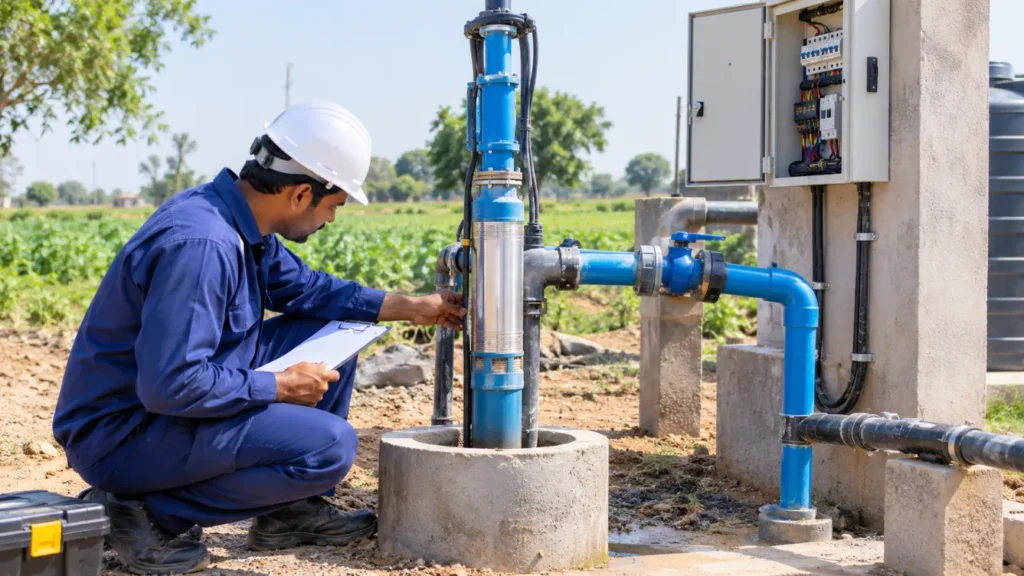
Is your borewell pump running, but no water is coming out of the tap? This can be a frustrating problem for homeowners, farmers, industries, and commercial property owners who depend on a reliable water supply.
When a submersible pump runs without delivering water, the problem may be related to a falling groundwater level, a faulty pump, an electrical issue, a damaged delivery pipe, or sediment inside the borewell.
The first step is to switch off the pump and identify the actual cause before restarting it or replacing equipment. Continuing to operate a pump without water flow can cause overheating and additional damage.
At Vishal Borewell Drilling Service, Vadodara, we understand the importance of proper borewell maintenance, professional troubleshooting, and technically sound solutions. This guide explains the common reasons for borewell water flow problems and what you should do next.
What Should You Do First When Your Borewell Pump Is Running Without Water?
If your borewell pump is running but no water is reaching the outlet, follow these precautions:
Switch off the pump: Do not allow it to continue running without water flow.
Check other taps: Determine whether the problem affects the entire property or only one outlet.
Inspect visible plumbing: Look for accessible leaks, damaged pipes, or accidentally closed valves.
Observe the control panel: Note any warning lights or fault codes without opening electrical covers.
Remember recent changes: Consider whether the issue started after a power interruption, extended pumping, or maintenance work.
These basic observations can help a technician diagnose the issue more efficiently. Do not open electrical equipment, dismantle pressurised pipe connections, or attempt to remove the submersible pump yourself.
6 Common Reasons Why a Borewell Pump Runs but No Water Comes Out
1. Low Groundwater Level
A falling groundwater level is one possible reason for a borewell pump to stop delivering water.
Groundwater availability can change due to seasonal conditions, rainfall, nearby pumping activity, and local geological characteristics. If the water level falls below the pump intake, the pump may be unable to draw water.
You may notice that water initially flows normally but gradually decreases or stops during extended pumping.
What is the solution?
A qualified technician can measure the groundwater level and compare it with the pump installation depth and operating conditions. Depending on the findings, the solution may involve adjusting pumping practices or evaluating the borewell and pump arrangement.
Do not assume that drilling deeper will automatically solve the problem. The appropriate solution depends on the local hydrogeological conditions.
2. Faulty Submersible Pump or Motor
A submersible pump may start running without generating sufficient pressure to lift water to the surface.
Possible causes include:
Worn or damaged pump impellers.
Damaged internal pump stages.
Mechanical wear.
Motor performance problems.
An unsuitable pump selection for the required head and flow.
You may also notice unusual noise, reduced water flow, or repeated activation of the pump’s protection system.
What is the solution?
Have the pump and motor inspected by a qualified pump technician. The technician should identify the fault before recommending repairs or replacement.
Replacing the pump without checking the entire system may result in unnecessary expenses if the actual problem lies elsewhere.
3. Damaged or Leaking Delivery Pipe
Water must travel from the submersible pump through the rising main and delivery pipe before reaching your storage tank or outlet.
A damaged pipe, loose joint, leaking connection, or faulty valve can prevent water from reaching the surface properly.
Sometimes, a leak is underground and cannot be identified through a simple visual inspection.
What is the solution?
Inspect accessible pipework and valves for visible damage. If the problem persists, arrange a professional inspection of the delivery system.
Never dismantle pressurised connections while the pump is operating.
4. Electrical or Control Panel Problems
A borewell pump depends on a suitable electrical supply and correctly functioning control equipment.
Voltage fluctuations, damaged cables, faulty starters, capacitor problems in applicable systems, or control panel faults may affect pump performance.
Warning signs can include repeated tripping, unusual humming, burning smells, or unexpected stopping and starting.
What is the solution?
Switch off the system if you notice these warning signs and contact a qualified electrician or pump technician.
Never bypass protection devices or touch exposed electrical wiring. Electrical faults can create serious shock and fire hazards.
5. Sediment, Mineral Deposits, or Borewell Blockage
Over time, sediment, mineral deposits, or debris may affect water flow or interfere with the pump intake.
A borewell that previously delivered satisfactory water but gradually develops reduced flow may require a professional assessment.
However, sediment is not the only possible explanation for a decline in water supply.
What is the solution?
Arrange a technical inspection to determine whether the problem requires borewell cleaning, flushing, or development.
Vishal Borewell provides borewell cleaning and maintenance services. Learn more about our borewell cleaning service.
Cleaning should be recommended only when the findings indicate that it is appropriate. It cannot guarantee increased groundwater availability.
6. The Submersible Pump Is Not Properly Submerged
A submersible pump must operate under suitable water-level conditions.
If the water level falls below the pump intake, or the installation depth is unsuitable for the current operating conditions, water delivery may stop or become inconsistent.
Pump depth alone does not establish whether the installation is correct. The water level, pumping rate, pump specifications, and borewell characteristics must also be considered.
What is the solution?
Ask a qualified technician to evaluate the pump position and water level. Do not attempt to lift, lower, or reposition the pump without the appropriate equipment and expertise.
Safe Checks You Can Perform Before Calling a Technician
Before arranging a service visit, you can collect useful information without attempting repairs.
| What to check | What it may indicate |
|---|---|
| Other taps and outlets | A local plumbing issue or a wider supply problem |
| Visible delivery pipes | An accessible leak or damaged connection |
| Control panel display | A fault warning or protection-system activation |
| Water storage tank | A closed valve or tank connection problem |
| Recent pumping duration | Possible changes in pumping conditions |
| Changes in water flow | A developing equipment or groundwater issue |
Record when the water supply last worked normally and whether the problem developed suddenly or gradually.
If the pump runs without water, switch it off. Do not repeatedly restart it in an attempt to restore the supply.
When Should You Call a Borewell Professional?
Arrange a professional inspection if:
The pump runs but no water comes out.
Water flow has gradually reduced.
The pump repeatedly trips its protection device.
You notice burning smells, unusual vibration, or unfamiliar noises.
Water becomes muddy, sandy, discoloured, or develops an unusual odour.
You suspect a leak in underground pipework.
The pump needs to be removed, repaired, or repositioned.
A proper diagnosis may involve checking the electrical supply, control panel, pump performance, delivery pipes, groundwater level, and borewell condition.
Ask the service provider to explain the identified problem and recommended repair before approving major work.
How Vishal Borewell Approaches Borewell Troubleshooting
A borewell water supply problem should be assessed systematically rather than addressed through guesswork.
At Vishal Borewell Drilling Service, our groundwater and borewell-related services support customers who need technical assistance with drilling, cleaning, and water-system maintenance.
Depending on the reported symptoms, an appropriate assessment may include:
Reviewing the history of water flow and pump operation.
Checking accessible delivery pipes and control equipment.
Evaluating groundwater-level concerns.
Assessing whether borewell cleaning or flushing is appropriate.
Recommending suitable pump-related technical support.
Explaining the likely cause and practical next steps.
The objective is to identify the actual problem before recommending work that may not be necessary.
Explore our borewell and groundwater-related services or contact Vishal Borewell to discuss your requirements.
How to Prevent Borewell Pump Problems
Although no maintenance routine can guarantee uninterrupted water availability, sensible operating practices can help reduce avoidable equipment problems.
1. Avoid unnecessary continuous pumping. If water flow starts declining, switch off the pump and arrange an assessment rather than continuing to operate it without adequate water.
2. Maintain the control panel. Have electrical protection devices and pump controls checked by qualified personnel.
3. Monitor water flow. Record noticeable changes in the time required to fill a storage tank or in the volume delivered.
4. Inspect accessible plumbing. Address visible leaks and damaged connections promptly.
5. Keep service records. Maintain details of the pump model, installation depth, repairs, and previous performance.
6. Arrange professional cleaning when indicated. Cleaning and flushing should be based on the condition of the borewell, not performed automatically for every water supply problem.
7. Test water quality when necessary. Clear-looking water is not necessarily safe for drinking. Use a qualified laboratory for appropriate water-quality testing.
Frequently Asked Questions
Why is my borewell pump running but no water is coming out?
Possible causes include a low groundwater level, a faulty pump, electrical or control problems, leaking delivery pipes, blocked valves, or sediment affecting the borewell. Switch off the pump and arrange a professional diagnosis.
Should I keep the pump running to see whether water returns?
No. If there is no water flow, switch off the pump. Continued operation may cause overheating or additional damage.
Can a low groundwater level cause a borewell pump to stop delivering water?
Yes. If the water level falls below the pump intake, the pump may be unable to draw water. A technician can measure the water level and assess the installation.
Does a borewell that delivers no water always need cleaning?
No. The cause may be electrical, mechanical, plumbing-related, or associated with groundwater conditions. Cleaning should be considered only after assessing the problem.
Why does my borewell deliver water for a few minutes and then stop?
The pump may be drawing water faster than the borewell can replenish it, or there may be a pump, pipe, or control-system problem. Switch off the pump if the problem continues and arrange an inspection.
When should I replace my submersible pump?
Replace the pump only after a qualified technician has assessed its condition and checked other possible causes, including electrical faults, pipe leaks, valve problems, and groundwater-level changes.
Can borewell cleaning increase water availability?
Professional cleaning may help when sediment or deposits are restricting the borewell. However, it cannot guarantee a higher yield or restore groundwater that is unavailable due to geological or aquifer conditions.
Is borewell water safe to drink if it looks clear?
Not necessarily. Harmful contaminants may be present even when water appears clear. Arrange suitable laboratory testing before relying on the water for drinking.
Conclusion: Diagnose the Problem Before Spending on Repairs
When your borewell pump is running but no water is coming out, avoid repeated restarting or immediately purchasing a replacement pump.
The problem may involve groundwater levels, the pump, electrical equipment, delivery pipes, or borewell condition. Identifying the actual cause is the most sensible first step toward selecting the right repair.
Vishal Borewell Drilling Service, Vadodara, Gujarat, provides borewell drilling, cleaning, groundwater-related services, and technical guidance for agricultural, residential, and industrial requirements.
Need help with a borewell water flow problem?
Contact Vishal Borewell Drilling Service to discuss your situation.
Vishal Borewell — Precision. Sustainability. Trust.