
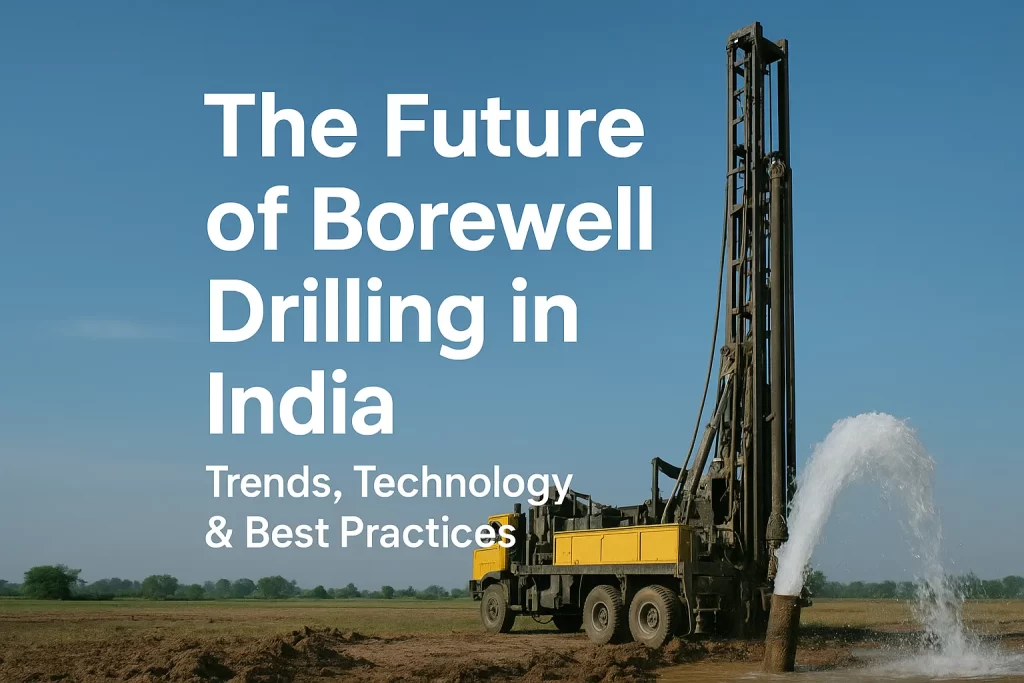
Advancing Borewell Drilling in India: Future Trends, Smart Technology & Sustainable Practices — Vishal Borewell
Water security will define India’s growth and resilience. As rainfall patterns change and demand rises, borewell drilling must evolve from traditional methods to integrated, technology-driven water solutions. At Vishal Borewel, we combine hydrogeology, smart monitoring, and sustainable design to deliver reliable, compliant, and long-lasting groundwater solutions.
What is changing in borewell drilling?
Borewell drilling is shifting from purely mechanical work to a data-driven service. Today, projects integrate hydrogeological surveys, precision rigs, telemetry, and recharge design. Consequently, success rates improve, environmental impacts reduce, and owners gain predictable, long-term supply.
Why these changes matter
Because groundwater is a shared and finite resource. Modern practices reduce the risk of dry wells, minimize over-extraction, and ensure regulatory compliance. For households, farms, and industries, this means lower operating cost, fewer disruptions, and more sustainable water availability.
Key trends shaping the future
1. Smart monitoring & telemetry (DWLR / IoT)
Real-time water-level data and remote telemetry help owners and regulators detect issues early, prevent over-extraction, and run predictive maintenance. Observation wells with DWLRs and telemetry-backed dashboards are becoming standard.
2. Energy-efficient pumps & solar integration
Submersible pumps with higher efficiencies, VFDs (variable frequency drives) where appropriate, and solar-powered systems lower energy costs and enable reliable off-grid operation.
3. Data-driven site selection (GIS & remote sensing)
Instead of drilling by hunch, modern projects use hydrogeological surveys, GIS mapping, and satellite indicators to choose optimal drill sites—reducing the chance of unsuccessful borewells.
4. Regulatory focus on monitoring and compliance
Central and state-level groundwater authorities now emphasize NOCs, telemetry for large extraction points, and reporting. Contractors must include compliance in project scope.
5. Recharge-first thinking
Pairing extraction with recharge — recharge wells, percolation pits, and rainwater harvesting — helps sustain aquifers over the long term.
Technology every modern borewell project should include
Pre-drilling hydrogeological survey (desktop + field).
Observation wells and piezometer installation for aquifer monitoring.
Digital Water Level Recorders (DWLR) and telemetry for continuous data.
Telemetry-enabled water meters and pump controllers.
Energy-efficient submersible pumps (solar-ready where useful).
GIS-based documentation to support permits and audit trails.
How Vishal Borewel applies these trends
We begin with a groundwater survey to recommend the best location and depth.
We propose DWLR/piezometer options and telemetry packages for long-term monitoring.
We select energy-efficient submersible pump systems and offer solar-ready solutions.
We design recharge or rainwater-harvesting measures to complement extraction.
We handle CGWA/State-level documentation and help with NOC processes where required.